
Car Price 2014 vs 2026: How Much More Are Indians Paying? (With Tax Breakdown)

India Auto Inflation · 2014 → 2026
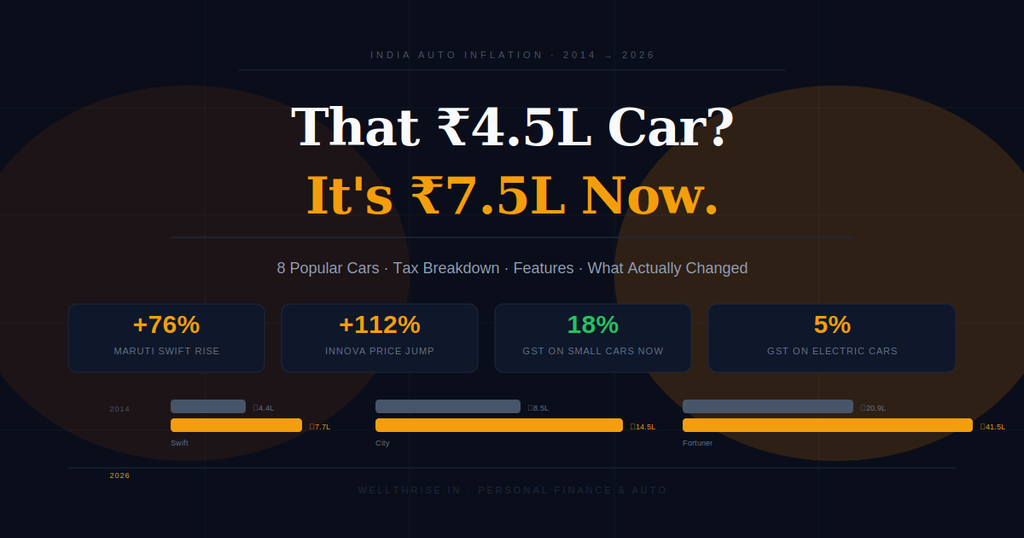
That ₹4.5 lakh car you eyed in 2014?
It costs ₹7.5–8 lakh today.
+68%
Avg small car price rise
+90%
Avg SUV price rise
18%
GST on small cars (was 29–31%)
12yr
Of compounding auto inflation

In May 2014, when the new government came to power, a Maruti Swift base variant cost ₹4.39 lakh. You could drive home a Honda City for ₹8.5 lakh. A Toyota Innova — the family workhorse — was ₹10 lakh. Fast forward to June 2026: those same nameplates cost 60–100% more.

But here’s what makes this story complicated: taxes changed dramatically too. India moved from a confusing excise+VAT regime to GST in 2017, then reformed GST again in September 2025. Some buyers actually pay less tax percentage today than in 2014. And the cars themselves are fundamentally different — safety features, tech, engines — all upgraded. So how much of that price rise is inflation, how much is better product, and how much is just government policy?

We tracked 8 of the most popular cars in India across both years — same segment, same position in each brand’s lineup — and broke down exactly what changed.

If your car budget was ₹6 lakh in 2014, the equivalent purchasing power in 2026 — accounting for general inflation — would be roughly ₹9–10 lakh. But car prices have risen faster than general CPI in most segments.

🚗 Interactive: Pick a Car and See What Changed

Select any car below to see its 2014 vs 2026 price, tax breakdown, mileage, and what features you now get for the money.

Choose a car
Maruti Suzuki Swift
Base petrol variant · Ex-showroom Delhi
+76% price rise
2014 price (LXi)₹4.39 lakh
2026 price (LXi)₹7.74 lakh
2014 Tax Effective
~29–31%
Excise 12% + VAT 12.5% + cess
2026 Tax (GST)
18%
Lower tax, but higher base price
Mileage 2014
18.4 kmpl
ARAI certified
Mileage 2026
24.8 kmpl
+35% fuel efficiency
Engine
1.2L K-Series
Same displacement
Safety (NCAP)
0 stars → 3 stars
Now has dual airbags standard
Maruti Suzuki Dzire
Entry compact sedan · Ex-showroom Delhi
+63% price rise
2014 price (LXi)₹5.14 lakh
2026 price (LXi)₹8.38 lakh
2014 Tax Effective
~29–31%
Sub-4m excise benefit applied
2026 Tax (GST)
18%
Sub-4m still qualifies small car
Mileage 2014
19.1 kmpl
Petrol manual
Mileage 2026
24.79 kmpl
+30% improvement
Diesel variant
Dropped in 2020
BS6 killed diesel option
CNG variant
Now available
New option added in 2026
Hyundai i20
Premium hatchback · Ex-showroom Delhi
+55% price rise
2014 price (Era)₹4.99 lakh
2026 price (Era)₹7.74 lakh
2014 Tax Effective
~29–31%
Pre-GST multi-tax regime
2026 Tax (GST)
18%
Clean single slab
Boot space 2014
295 litres
Standard for segment
Boot space 2026
311 litres
+16L improvement
Touchscreen 2014
Not in base
Optional in higher trims
Touchscreen 2026
Standard
Even entry trim gets display
Honda City
C-segment sedan · Ex-showroom Delhi
+70% price rise
2014 price (S MT)₹8.50 lakh
2026 price (V MT)₹14.50 lakh
2014 Tax Effective
~33–37%
Higher excise for >1200cc
2026 Tax (GST)
40%
Over 4m = large car slab
Airbags 2014
2 airbags
Driver + passenger
Airbags 2026
6 airbags
Side + curtain added standard
ADAS 2014
None
No driver assistance
ADAS 2026
Honda Sensing
Lane assist, AEB standard
Hyundai Verna
C-segment sedan · Ex-showroom Delhi
+83% price rise
2014 price (base)₹7.90 lakh
2026 price (base)₹10.99 lakh
2014 Tax Effective
~33–37%
Complex pre-GST structure
2026 Tax (GST)
40%
Over 4m = large car slab
Diesel 2014
Available (CRDi)
Popular option in 2014
Diesel 2026
Discontinued
BS6 Phase 2 made it unviable
Sunroof 2014
Not available
Not offered in segment
Sunroof 2026
Panoramic
Now a segment standard
Hyundai Creta
Compact SUV · Ex-showroom Delhi
+78% price rise
2015 launch price (base)₹8.59 lakh
2026 price (base)₹11.11 lakh
Tax 2015
~45% effective
SUV cess applied in old regime
2026 Tax (GST)
18%
Sub-4m qualifies for small car!
Engine 2015
1.6L petrol / diesel
Larger engines
Engine 2026
1.5L turbo petrol
Smaller, more efficient
Connected car 2015
None
No OTA, no connected features
Connected car 2026
BlueLink + OTA
Remote start, geofencing, OTA updates
Toyota Innova
MPV · Innova 2014 → Innova Crysta 2026
+113% price rise
2014 price (2.0 G)₹10.07 lakh
2026 price (GX base)₹21.39 lakh
Tax 2014
~45–50%
MUV cess was steep
2026 Tax (GST)
40%
Over 4m large vehicle slab
Seats 2014
7–8 seats
Standard MPV config
Seats 2026
7–8 seats
Same, but captain seats option
Engine 2014
2.0L petrol / 2.5L diesel
BS3/BS4
Engine 2026
2.7L petrol only (Crysta)
Diesel dropped post BS6
Toyota Fortuner
Full-size SUV · Ex-showroom Delhi
+100% price rise
2014 price (2.7L petrol base)₹20.93 lakh
2026 price (2.7L base)₹41.50 lakh
Tax 2014
~50–55%
Luxury SUV cess was punishing
2026 Tax (GST)
40%
Still high, but simplified
4WD 2014
4WD standard
Manual shift 4WD
4WD 2026
4WD + electronic
Electronic terrain modes added
Diesel 2014
3.0L D4D available
Most popular variant
Diesel 2026
2.8L GD available
Updated engine, still offered

📊 All 8 Cars — 2014 vs 2026 Price Comparison

Base variant, ex-showroom Delhi. 2014 prices sourced from archived CarWale/CarDekho records. 2026 prices from manufacturer websites (June 2026).

Car Segment 2014 Price 2026 Price Rise CAGR
Maruti SwiftHatchback₹4.39L₹7.74L+76%4.9%
Maruti DzireCompact Sedan₹5.14L₹8.38L+63%4.2%
Hyundai i20Prem. Hatchback₹4.99L₹7.74L+55%3.7%
Honda CitySedan₹8.50L₹14.50L+71%4.6%
Hyundai VernaSedan₹7.90L₹10.99L+39%2.8%
Hyundai CretaCompact SUV₹8.59L*₹11.11L+29%2.0%
Toyota InnovaMPV₹10.07L₹21.39L+112%6.5%
Toyota FortunerFull-size SUV₹20.93L₹41.50L+98%5.9%

*Creta launched mid-2015. 2026 CAGR calculated from 2015. CAGR = Compound Annual Growth Rate. India CPI inflation CAGR over same period: ~5.2%.

🧾 How Taxes Changed — 2014 Pre-GST vs 2026 GST 2.0

This is the part most buyers don’t fully understand. India’s car tax structure changed dramatically twice — first with GST in 2017, then again with GST Reform 2.0 in September 2025.

2014 — Pre-GST Regime
Small car (e.g. Swift)
29–31%
  • Excise Duty: 12%
  • VAT: 12.5% (state-wise)
  • Cess: 1–3%
  • Road tax: 4–12% extra
  • Octroi (some states): 5%+
  • Multiple filings, cascading tax
2026 — GST 2.0 (Post Sept 2025)
Small car (e.g. Swift)
18%
  • Single GST slab: 18%
  • No compensation cess
  • No cascading effect
  • Road tax still applies (state)
  • Transparent, uniform nationwide
  • EV: just 5% GST

The important nuance: smaller cars are now taxed less than in 2014, but larger cars (over 4m) moved to 40% GST flat. For a Honda City or Verna buyer, the effective tax burden has actually gone up versus 2014 in some cases.

Vehicle Type2014 Effective Tax2026 GST RateChange
Small car (petrol ≤1200cc, ≤4m)~29–31%18%▼ Cheaper
Sedan / Car over 4m~33–37%40%▲ Costlier
Compact SUV (sub-4m)~40–45%18%▼ Much cheaper
Full-size SUV~45–55%40%▼ Slightly better
Electric Vehicle~30–35%5%▼▼ Dramatically cheaper
Luxury car~50–55%40%▼ Marginally better

🛠️ What ₹5 Lakh Bought You — Then vs Now

Price rise is only half the story. Cars in 2026 are fundamentally different products from their 2014 counterparts. Here’s a feature-by-feature reality check on what the same-segment car offers today versus 12 years ago.

Feature comparison — same price segment, 2014 vs 2026
Airbags
❌ 0–2 airbags (basic trim)
✅ 6 airbags now standard (post 2023 mandate)
Touchscreen
❌ Not available in base trim
✅ 7–9″ touchscreen standard
Reverse camera
❌ Rare, only top variants
✅ Mandatory by govt since 2019
ABS + EBD
❌ Optional on small cars
✅ Mandatory on all cars since 2019
Fuel efficiency
18–20 kmpl (hatchback)
23–26 kmpl (same segment)
Emission norm
BS4 (dirtier)
BS6 Phase 2 (much cleaner)
Connected features
❌ None
✅ OTA updates, remote access, app connectivity
Diesel option
✅ Available (most segments)
❌ Dropped by most brands (BS6 cost)
NCAP safety rating
0–1 star (most budget cars)
3–5 stars (Bharat NCAP mandate)
CNG option
Very limited
✅ Wide availability (Maruti, Hyundai)
Electric option
❌ Practically none
✅ Tata Punch EV, Nexon EV, MG etc.

🔍 Why Have Car Prices Risen So Much?

India’s auto price story isn’t a single event — it’s several structural forces layered on top of each other over 12 years.

FactorImpactWhich cars affected most
BS4 → BS6 Emission Upgrade+₹50,000–1.5L per carAll petrol and diesel cars
Safety Mandate (6 airbags, ABS, rear cam)+₹30,000–80,000Small and mid-size cars most
Steel & raw material inflation+15–25% to production costAll segments
Rupee depreciation (₹60 → ₹95/USD)+Higher import component costsPremium, luxury, import-heavy brands
GST on inputs (transitional)Mixed — some savings passedSmall cars benefited, large cars didn’t
R&D + connected tech features+₹20,000–50,000 per carMid and premium segments
COVID supply chain disruptionOne-time cost spike 2021–23All, especially chip-heavy models

❓ Frequently Asked Questions

Are cars in 2026 actually worse value than in 2014, considering price rises?
Not entirely. A significant portion of the price rise reflects genuine product improvement — 6 airbags, BS6 engines that are 80% cleaner, 30–35% better fuel efficiency, connected tech, and better safety ratings. The 2026 Swift is meaningfully safer and more efficient than the 2014 Swift. However, the base price inflation (4–6% CAGR) has outpaced general CPI inflation (~5.2% CAGR) in some segments, meaning affordability has declined for entry-level buyers even accounting for income growth.
Which segment saw the biggest price jump — hatchbacks, sedans, or SUVs?
MPVs and full-size SUVs saw the biggest absolute and percentage jump — the Innova doubled in price (+112%) and the Fortuner nearly doubled (+98%). Among smaller cars, hatchbacks like the Swift (+76%) rose more than sedans like the Verna (+39%). Compact SUVs like the Creta saw the smallest rise (+29% from 2015) partly because they launched expensive and partly because the GST 2.0 reform dropped their tax rate significantly.
Why did diesel variants disappear from so many models?
BS6 Phase 2 emission norms (implemented April 2023) made diesel engines extremely expensive to upgrade and maintain. The cost of adding the required after-treatment systems (DPF, SCR, AdBlue) to small-displacement diesel engines made them uneconomical. Maruti Suzuki exited diesel entirely in 2020. Hyundai dropped diesel from the Verna. Only larger vehicles like the Fortuner and Innova Crysta retained diesel because the cost could be spread over a higher price point.
Has GST actually made cars cheaper in India?
For small cars (under 4m) — yes, significantly. GST 2.0 (September 2025) dropped small car tax to 18% from the previous 28–31%. On a ₹8 lakh car, that’s roughly ₹80,000 in tax savings versus the old structure. But for sedans and larger cars (over 4m), the 40% GST rate means buyers in some cases pay more tax than under the old excise+VAT regime. Electric vehicles are the clear winner — 5% GST versus 30–35% under pre-GST rules.
What is the cheapest new car you can buy in India in 2026?
The Maruti Alto K10 starts at approximately ₹3.99 lakh (ex-showroom), making it the most affordable new car in India. In 2014, the Alto 800 started at ₹2.44 lakh. That’s a 64% increase over 12 years. The second-cheapest option is the Maruti S-Presso at ~₹4.26 lakh. Tata Punch EV (electric) starts at ₹5.75 lakh — the cheapest new electric car.
Will car prices continue to rise in 2026 and beyond?
Maruti Suzuki already hiked prices by up to ₹30,000 across all models in June 2026, citing rising input costs. Most manufacturers review prices bi-annually. The structural factors driving prices up — steel inflation, safety mandates, technology upgrades, and rupee weakness — have not gone away. EVs are likely to become cheaper as battery costs fall, but ICE (petrol/CNG) car prices are expected to continue rising at 3–5% annually. CNG cars are emerging as the new value option as petrol prices stay elevated.

The Bottom Line

If your 2014 salary let you buy a Swift for ₹4.4 lakh, you now need ₹7.7 lakh — a 76% jump — for the equivalent entry-level Swift. The car is better: safer, cleaner, more efficient. But the affordability ladder has shifted significantly. Entry-level buyers who needed ₹4–5 lakh in 2014 now need ₹7–9 lakh for the same position in the market.

The tax story cuts both ways. Small car buyers are taxed less than ever (18% vs 31%). Large car and SUV buyers pay 40% flat — higher than some old regime rates. The diesel option has effectively vanished below ₹20 lakh. CNG is the new “affordable fuel” story. And EVs — still pricey today — are the segment most likely to democratise in the next 5 years.

The real squeeze: car prices have grown at 4–6% CAGR while general inflation ran at ~5.2%. The gap is small but compounding — and for households where income hasn’t kept pace, the ₹5 lakh family car is now firmly a ₹8–9 lakh purchase. That’s not a footnote. That’s 12 years of financial pressure, visible every time you walk into a showroom.

Sources & Disclaimer: 2014 prices from CarWale, CarDekho archived data and government motor vehicle sales records. 2026 prices from manufacturer websites (June 2026). Tax rates from ClearTax, GST Council notifications. All prices are base-variant ex-showroom Delhi unless noted. On-road prices (including registration, insurance, road tax) will be 10–20% higher. This post is for informational purposes only and does not constitute financial advice. Prices vary by city, state, and dealer.
car price 2014 vs 2026

Wellthrise.in Calorie burn Calculator

Cardekho

Leave a Comment

Your email address will not be published. Required fields are marked *

Scroll to Top