
Ate it? See the calories. See what they mean for your body. See the activity equivalent.
🍛 Indian Foods • 🏃 Running • 🚴 Cycling • 🪜 Stairs • 🤸 Push-Ups • + More
🔥 Calorie Burn Calculator Pro
See exactly what you ate, and exactly how much movement it takes to burn it off — in pushups, squats, kilometres and steps.
Your Profile
What did you eat?
Basal Metabolic Rate & Daily Burn
Cut / Bulk Timeline
Body Fat % Estimator
Macro Split Planner
Weight Projection
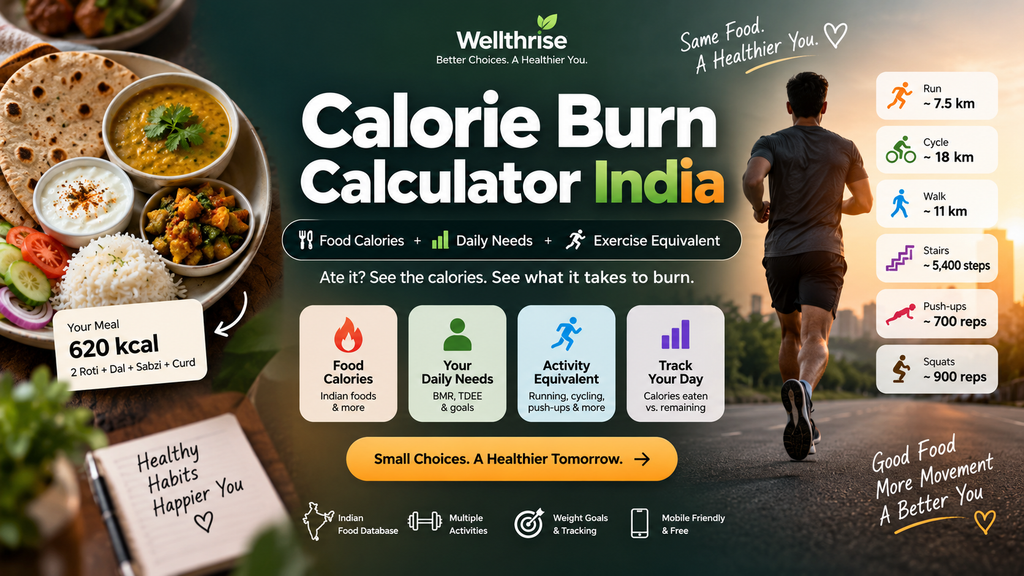
How This Calorie Burn Calculator Works
The Wellthrise Calorie Burn Calculator helps you understand not just how many calories are in your food, but what those calories mean for your body.
Enter your age, sex, height, weight and activity level, then select the food you ate. The calculator estimates:
- Calories consumed
- Your daily calorie requirement
- BMR and TDEE
- Calories remaining for the day
- Equivalent activity such as running, cycling, walking, push-ups, squats and stairs
For example, if a meal contains 600 calories, the calculator may show how much running, cycling or stair climbing would use roughly the same amount of energy.
These are activity equivalents, not a recommendation to “burn off” every meal.
Why Your Body Details Matter
The calories in food stay the same regardless of who eats it.
What changes is your body’s daily energy requirement and exercise calorie burn.
A person weighing 90 kg will generally burn more calories during the same activity than someone weighing 60 kg. Your age, height, sex, weight and activity level also help estimate your BMR and TDEE.
BMR is the energy your body needs for basic functions such as breathing, circulation and organ function.
TDEE is your estimated total energy expenditure during the entire day, including movement and exercise.
Indian Food Calories Can Vary 🍛
Foods like roti, dal, rice, paneer, biryani, dosa, poha, samosa and chai can vary significantly depending on portion size, ingredients and cooking method.
For example:
Homemade dal ≠ restaurant dal tadka.
Plain dosa ≠ cheese butter masala dosa. 😂
That’s why all food calorie values should be treated as practical estimates rather than exact numbers.
How Accurate Are Calories Burned During Exercise?
Running, cycling, walking and other exercise calorie estimates depend on factors such as:
body weight, speed, distance, intensity, terrain and fitness level.
Activities measured in repetitions — such as push-ups and squats — are harder to estimate precisely because pace and rest time vary.
So if the calculator says a meal equals approximately 500 push-ups, don’t take that as an exact scientific conversion.
It simply helps you understand the energy equivalent.
Do I Need to Burn Every Calorie I Eat?
No.
Your body burns calories all day — even while sleeping, sitting and breathing.
Exercise is only one part of your total daily calorie expenditure.
The goal of this calculator is to help you understand food and activity better, not make you feel that every meal needs to be “earned” through exercise.
Use calories as information, not punishment. ❤️
Frequently Asked Questions
How many calories should I eat per day?
Your estimated calorie requirement depends on your age, sex, height, weight and activity level. Use the calculator above to get a personalised estimate.
How many calories does running 1 km burn?
It depends mainly on body weight, pace and terrain. A heavier person will generally burn more calories over the same distance.
How many calories do 100 push-ups burn?
There is no fixed number. Body weight, speed, form and rest time all affect calorie expenditure, so push-up calculations are approximate.
Does weight affect calories burned?
Yes. Body weight significantly affects estimated energy expenditure during activities such as walking, running, cycling and climbing stairs.
Do food calories change according to my body weight?
No. The food contains the same calories. Your body weight and other details affect your calorie needs and how much energy you burn.
Important Disclaimer Calorie Burn Calculator
The Wellthrise Calorie Burn Calculator provides educational estimates only. Actual food calories and exercise energy expenditure can vary based on serving size, cooking method, body composition, metabolism and exercise intensity.
It should not replace personalised medical or dietary advice from a qualified healthcare professional.