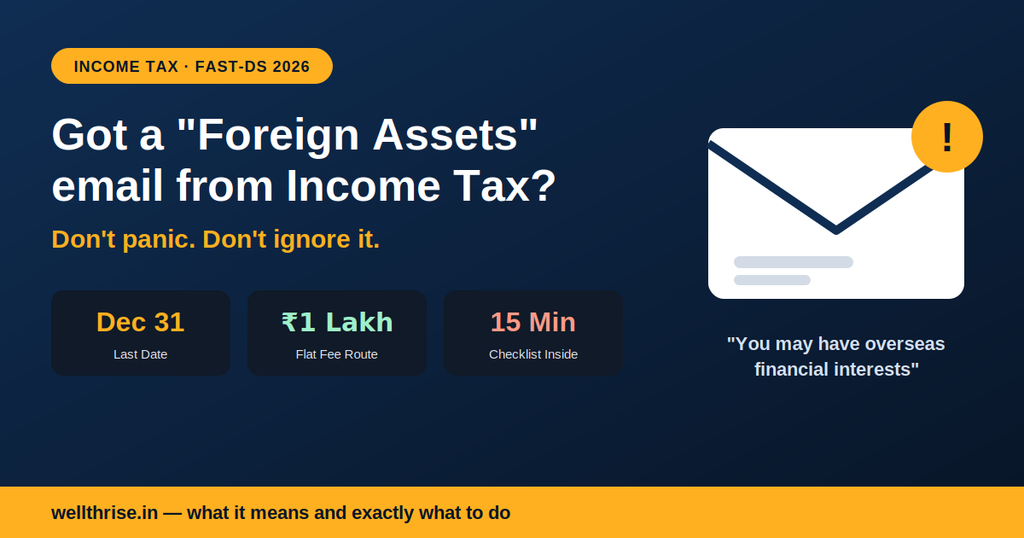
Got a “Foreign Assets” Email From the Income Tax Dept? Read This First
Don’t panic. Don’t ignore it either. Here’s what FAST-DS 2026 means, whether it applies to you, and exactly what to do in the next 15 minutes.
Thousands of Indian taxpayers have opened their inbox to an email from the Income Tax Department saying, in effect, we know you may have money abroad. If you’re one of them, the first thing to know is that this is not a notice and not a tax demand. The second thing to know is that it’s tied to FAST-DS 2026, a one-time disclosure scheme that closes on December 31, 2026, and ignoring it could cost you far more later.
This guide explains what the email means, who FAST-DS 2026 is actually for, what it costs, and a 15-minute checklist to work out where you stand tonight.
What the Email Actually Says
There are two messages going around. The first, sent from late July 2026, told taxpayers a new Foreign Assets Information (FAI) report was available in their AIS. The newer one, linked to FAST-DS 2026, reads roughly like this:
Paraphrased illustration based on reported wording. Your email may differ slightly.
Why you got it
India receives data on its residents’ foreign accounts from around 111 countries, including the US, UK, UAE, Singapore, Switzerland and Hong Kong, under the Common Reporting Standard (CRS) and the US FATCA agreement. Foreign banks and brokers report your PAN, account numbers, balances, interest, dividends and sale proceeds. The department has matched that data to your PAN and noticed it may not line up with what you declared in your ITR.
✅ What this email is NOT
- Not a scrutiny or reassessment notice
- Not proof that you evaded tax
- Not a demand to pay anything
- Not an automatic instruction to file under FAST-DS
⚠️ What it IS
- A signal the department holds third-party data on you
- A prompt to reconcile that data with your returns
- A pointer to a cheaper fix that ends December 31
- A paper trail: “I didn’t know” gets harder after this
What Is FAST-DS 2026?
FAST-DS 2026 stands for the Foreign Assets of Small Taxpayers – Disclosure Scheme, 2026. It was introduced in the Finance Act, 2026 and notified on August 15, 2026. It lets individuals who missed reporting foreign assets or income come clean at a fixed cost, in exchange for immunity from further tax, penalty and prosecution under the Black Money Act, 2015.
| Item | Details |
|---|---|
| Window | August 16 – December 31, 2026 |
| Who can use it | Individuals who were resident in India when the income arose or asset was acquired, even if they’re NRIs now |
| Valuation date | March 31, 2026 |
| How to file | Form 1 on the income tax e-filing portal → department issues Form 2 (amount due) within a month → pay and file Form 3 → Form 4 certificate |
| Payment time | 2 months from Form 2, extendable by 2 more months at 1% interest per month |
| Not available if | Money-laundering proceedings are pending, or Black Money Act assessment is already complete for that year |
The Two Categories and What Each Costs
Money never taxed in India
60% of value30% tax plus an equal additional amount. Aggregate limit: ₹1 crore.
- Foreign income you never offered to tax
- Assets whose source you can’t explain from taxed money
Taxed money, just not reported
₹1 lakh flatA flat fee, whatever the value. Aggregate limit: ₹5 crore.
- Bought with income already taxed in India
- Earned while you were a non-resident
- You just missed Schedule FA in your ITR
Watch the limits: they apply to the total across all your assets in a category. Go even slightly over, and that whole category is out of the scheme.
Which Bucket Are You In? A 60-Second Check
🧭 FAST-DS 2026 Quick Checker
Four questions. This gives you a starting point to take to your CA, not a legal opinion.
1. Were you an Indian tax resident (ROR) while you held a foreign account, shares or property?If you only held it while living abroad as an NRI and closed it before returning, answer No.
2. Did you report every foreign asset in Schedule FA, and foreign income in Schedule FSI, in each year’s ITR?
3. Was the money behind these assets already taxed in India, or earned while you were a non-resident?e.g. RSUs taxed as salary, savings sent abroad from taxed income, a US salary account from your NRI years.
4. Is the total value of these assets (as on March 31, 2026) ₹5 crore or less?
Likely nothing to fix
If everything was in Schedule FA and FSI, reconcile your AIS Foreign Assets report against your returns and mark the entries “Correct” on the compliance portal. Keep your statements handy.
You may have had no reporting duty
Assets held only while you were a non-resident usually didn’t need Schedule FA. Check your residential status year by year with a CA, and use the portal to mark entries that don’t pertain to you as a resident.
Looks like Category 2: ₹1 lakh flat
Taxed money, but not reported. This is the cheapest fix in the scheme and usually the most common situation. Talk to a CA about filing Form 1 before December 31, 2026.
Looks like Category 1: 60% of value
Some income or assets were never taxed. If the total is within ₹1 crore, FAST-DS costs about half what the Black Money Act would. Get a CA to value it properly before December 31.
Above the scheme limit
Above ₹5 crore, Category 2 isn’t available. You need specialist advice on correcting your returns directly. Don’t wait for a notice.
What to Do in the Next 15 Minutes
⏱️ Your 15-Minute Checklist
Tick each step as you go.
Who Usually Gets This Email
Tech employees with RSUs/ESOPs
Shares from a US parent company taxed on vesting, but never listed in Schedule FA, or dividends never reported.
Returning students and NRIs
An old US, UK or Canada bank account left open after moving back to India.
Global investors
US stocks bought through apps under the LRS route, but left out of Schedule FA.
Retirement account holders
401(k)s, pensions or similar accounts from past jobs abroad.
Note that RSUs taxed as salary have an explained source, so the shares themselves typically fall in the cheaper bucket. It’s the unreported dividends or sale gains on them that are never-taxed income.
FAST-DS vs Ignoring It: What It Could Cost
🧮 Cost Comparison Calculator
Enter the value of foreign assets or income that was never taxed in India (Category 1 type).
Illustrative only. Under the Black Money Act, a separate ₹10 lakh penalty per year for non-reporting can also apply, and prosecution is possible. If your money was already taxed (Category 2), the FAST-DS cost is a flat ₹1 lakh instead.
The ₹20 lakh relief most people don’t know about
Since October 1, 2024, the ₹10 lakh penalty for not reporting a foreign asset doesn’t apply if your foreign assets, other than immovable property, total ₹20 lakh or less. That’s real relief for small accounts. But it only covers the reporting penalty. Any foreign income you never paid tax on is still taxable, and you still have to report the assets going forward.
Your Other Options (and Their Limits)
| Option | Good for | Limit |
|---|---|---|
| Revised return for AY 2026-27 | Fixing this year’s Schedule FA and FSI | Only this year; deadline December 31, 2026 |
| Updated return (ITR-U) | Paying tax on missed income | No Black Money Act immunity |
| FAST-DS 2026 | Cleaning up past years with immunity | ₹1 crore / ₹5 crore limits; ends December 31, 2026 |
| AIS portal feedback | Flagging data that’s wrong or not yours | Doesn’t fix a genuine omission |
🎣 Watch out for fake “Income Tax” emails
- The genuine email asks you to review your AIS. It doesn’t ask for a payment, OTP, password or card details.
- Never click links or download attachments. Log in directly at incometax.gov.in.
- Check the sender domain ends in .gov.in. Look-alike domains are a red flag.
- Anyone offering to “settle” your case for a fee over WhatsApp is not the department.
The Bottom Line
This email is the department showing its hand: it already has your foreign account data. For most salaried people, the fix is small, often a ₹1 lakh flat fee or simply a clean reconciliation. The real risk isn’t the email. It’s letting December 31 pass and then facing the Black Money Act at 120% plus penalties. Spend 15 minutes tonight, see a CA this week, and close it out.
Frequently Asked Questions
This article is for general information and isn’t tax or legal advice. FAST-DS eligibility depends on your residential status, the source of funds and valuation rules. Please consult a chartered accountant before filing anything.
Sources: Income Tax Department — FAST-DS 2026 FAQs, KPMG, TaxGuru, CA Sahuja, AskCASanjay.