
New FD Rules 2026: 4 RBI Changes From October 1 Every Depositor Must Know
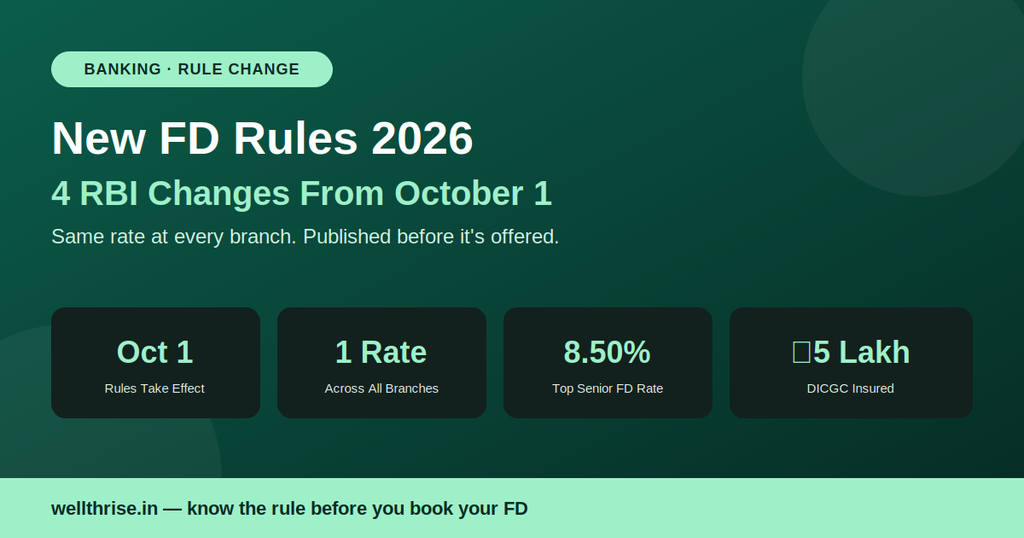
From October 1, your bank can no longer quote one FD rate at one branch and a different one down the road. Here’s what the new FD rules change, what they don’t, and how to get the best rate under them.
The new FD rules 2026 from the Reserve Bank of India kick in on October 1, 2026, and they fix a problem most depositors never realised they had. Until now, two branches of the same bank could quietly offer you different interest rates on the same fixed deposit, on the same day. Your rate often depended on which branch you walked into, or how hard your relationship manager pushed. From October 1, that ends.
These new FD rules 2026 apply to commercial banks, small finance banks, regional rural banks, local area banks, payments banks and urban cooperative banks. In short: almost every place an Indian household keeps a fixed deposit.
Already have an FD? Relax. The new FD rules apply only to deposits you open or renew from October 1, 2026. The rate on your existing FD stays exactly as contracted until maturity.
Old vs New FD Rules: What Actually Changes
❌ Before October 1
- Rates could differ between branches of the same bank
- You often relied on a verbal quote from branch staff
- Bulk rates were negotiated privately, with little disclosure
- Hard to compare what “the bank’s rate” actually was
✅ From October 1
- Same deposit, same day = same rate at every branch
- Rate schedules must be published on the bank’s website first
- Bulk deposit rates posted daily by 10:10 AM
- Interest must be paid strictly as per the published schedule
The 4 Key Changes in the New FD Rules 2026
1. One Rate Across Every Branch
Banks must offer the same interest rate for deposits of a similar amount accepted on the same day, whichever branch you use. No more branch-shopping inside the same bank, and no more “special rate” that exists only at one location.
2. Rates Published Online Before They’re Offered
Banks must upload their FD interest rate schedules to their official website in advance. If a rate isn’t published, it shouldn’t be offered to you. This gives you a written benchmark to check any quote against.
3. Daily Disclosure for Bulk Deposits
A single rupee term deposit of ₹3 crore or more counts as a bulk deposit for scheduled commercial banks and small finance banks. Those rates must be published by 10:00 AM every business day, with a 10-minute grace period.
4. Liquidity-Based Pricing for Big Deposits
Banks get flexibility to price bulk deposits differently based on liquidity risk under the Liquidity Coverage Ratio framework. But even those rates must be disclosed and applied uniformly, not negotiated behind closed doors.
What the New FD Rules Do NOT Change
This is where a lot of the viral coverage gets it wrong. The new FD rules are about transparency, not returns. They do not:
- Raise or lower FD interest rates. Banks still set rates based on their funding needs and market conditions.
- Change your existing FD. Contracted rates on current deposits stay the same.
- Change premature withdrawal penalties or how interest is calculated.
- Remove senior citizen rates. Those continue, but must now be published and applied consistently too.
FD Interest Rates Right Now (September 2026)
Because the new FD rules 2026 make every bank publish its rate card, comparing banks gets much easier. Here’s where the highest rates at major banks stand today:
| Bank | Highest General Rate | Senior Citizen (up to) |
|---|---|---|
| SBI | 6.45% (2–3 yrs) | Check SBI site |
| HDFC Bank | 6.50% (36–55 months) | 7.00% |
| ICICI Bank | 6.50% | 7.10% |
| Axis Bank | 6.50% (18–120 months) | 7.00% |
| Bank of Baroda | 6.25% | 7.25% (555 days) |
| PNB | 6.25% (2–3 yrs) | Check PNB site |
| Suryoday SFB | 8.25% (5 yrs) | 8.50% |
| Utkarsh SFB | 8.10% (666 days) | 8.25% |
| Jana SFB | 8.00% (24–30 months) | 8.30% |
Rates as reported in September 2026 and change often. Always confirm on the bank’s official website, which the new FD rules now require banks to keep updated.
Notice the gap: small finance banks are paying up to 1.75 percentage points more than the big banks. On a ₹5 lakh FD over 3 years, that difference is worth roughly ₹30,000. Deposits in any RBI-licensed bank, including small finance banks, are insured by DICGC up to ₹5 lakh per depositor per bank.
🧮 FD Maturity Calculator
See what your FD grows to. Uses quarterly compounding, which most Indian banks follow.
How to Get the Best FD Rate Under the New Rules
Check the bank’s website before you visit
Pull up the official FD rate schedule for your tenure. That published number is now the rate you are entitled to.
Match the quote to the published schedule
If a branch or app quotes something different, ask them to show you where it appears on the published rate card.
Compare banks, not branches
Branch-hopping inside one bank no longer helps. Comparing across banks, including small finance banks, is where the real difference now lies.
Get the rate in writing
Keep the FD receipt or confirmation showing the rate. It’s your proof if the credited interest ever doesn’t match.
Our Take
The new FD rules won’t make you richer overnight, and anyone telling you FD rates are “going up from October 1” is overselling it. What they do is quietly shift power to the depositor. For the first time, the rate on the bank’s website is the rate you’re owed, at any branch, on any day. Use that. Check the published schedule, compare across banks, and don’t leave a full percentage point on the table just because your nearest branch is convenient.
Frequently Asked Questions
Sources: Goodreturns, Teji Mandi, Reserve Bank of India, Stable Money. This article is for information only and is not financial advice.
Pingback: New Rules From October 1, 2026: 8 Changes That Hit You