Money Health Score: Free 3-Minute Financial Check-up (India)
🩺 Free check-up · 3 minutes
What’s Your Money Health Score?
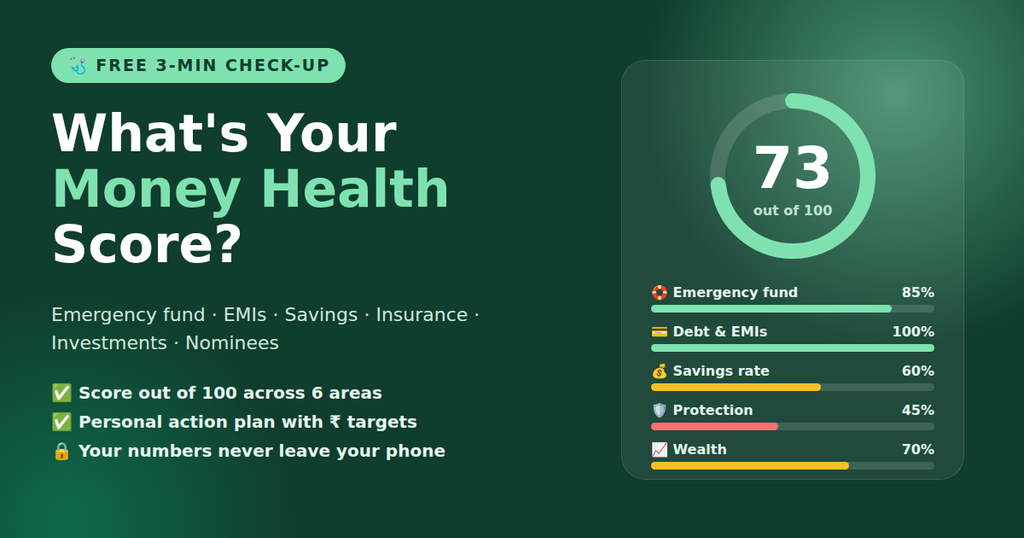
Answer 13 quick questions about your income, savings, loans and insurance. You’ll get a score out of 100, see where you’re strong and where you’re exposed, and get a personal action plan with real ₹ targets, based on the rules financial planners use.
6health areas checked
₹exact targets for you
100point score to share
🔒Your numbers never leave your phone. Everything is calculated in your browser. Nothing is sent, saved or tracked, and the share card shows only your score, never your amounts.
1/13
Checking your emergency fund…
0out of 100
Your 6 health areas
Your key numbers
Your action plan, in priority order
📸 Share your score
The card shows your score and areas only. None of your amounts are on it. Challenge friends to beat it.
Instagram: on your phone, tap “Share my Money Health Score” and pick Instagram. If it isn’t listed, the card is saved to your gallery, so add it to your Story from there.
How the Money Health Score works
The Money Health Score adds up six areas that financial planners look at first. Each one uses a widely used rule of thumb, so your result shows how far you are from a sound baseline, not how you compare with other people.
Area
Points
What full marks look like
🛟 Emergency fund
20
6 months of expenses + EMIs kept in savings, liquid funds or breakable FDs
💳 Debt & EMIs
20
Total EMIs at or below 20% of take-home pay, and credit card bills paid in full
💰 Savings rate
15
Saving or investing at least 20% of take-home pay every month
🛡️ Protection
25
Term cover of 10× annual income if anyone depends on you, plus your own health policy of ₹10 lakh or more
📈 Wealth progress
15
Investments on track for your age (about 1× annual income by 30, 3× by 40, 6× by 50, 8× by 60) with a growth mix suited to your age
📄 Paperwork
5
Nominees on every account and policy, and a written will
Frequently asked questions
Yes. The calculator runs entirely in your browser. Your numbers aren’t sent to any server, saved or tracked, and the share card shows only your score.
A common guideline is 6 months of essential expenses plus EMIs, kept somewhere you can reach within a few days: a savings account, a liquid fund or FDs you can break. If your income is irregular or you’re the only earner, aim higher.
If anyone depends on your income, a common starting point is 10–15 times your annual income, plus any outstanding loans. Count only pure term plans. Endowment and money-back policies usually give much smaller cover for the premium.
Employer cover ends when you change or lose your job, and it’s often too small for a family. Having your own family floater, ideally ₹10 lakh or more in a city, means you’re covered no matter where you work. A super top-up is a cheap way to raise cover.
Below 20% is comfortable. Up to 30–40% is manageable, but it leaves little room for saving. Above 50% is risky: one emergency can push you towards more borrowing. Lenders typically cap total EMIs at around 40–50% of income.
Start with the first action in your plan, since it’s ordered by impact. For most people the sequence is: clear credit card debt, build an emergency fund, buy term and health cover, then raise investments.
This check-up uses general rules of thumb for educational purposes. It isn’t personalised financial, tax or insurance advice. Your situation may need different targets, so consider speaking with a SEBI-registered investment adviser before making major decisions.