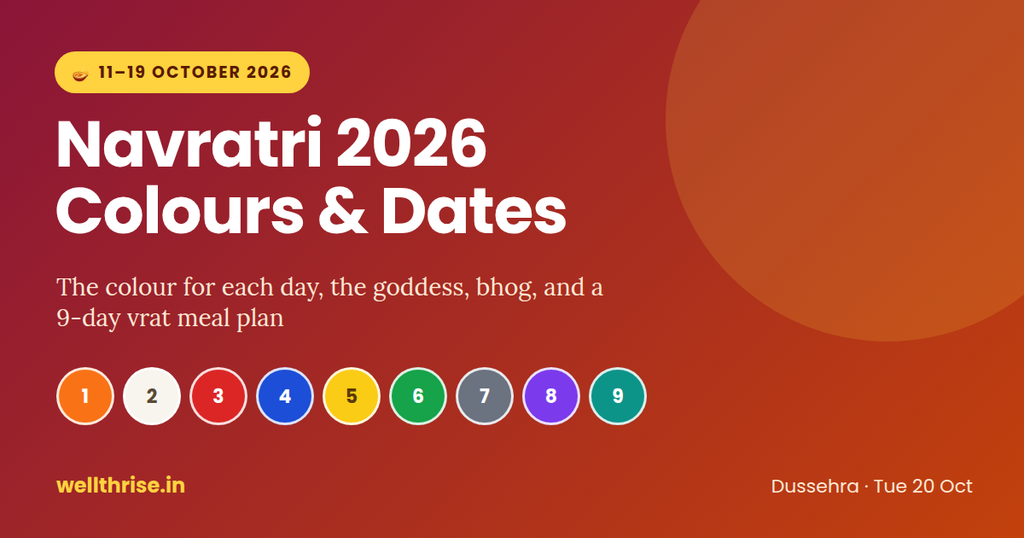
Navratri 2026 colours, dates and a 9-day vrat meal plan
Everything for the nine nights in one place: the colour to wear each day, the goddess worshipped, the traditional bhog, and a simple fasting menu that keeps your energy and protein up.
Navratri begins with Ghatasthapana. Morning muhurat: about 6:26 to 10:17 AM.
Navratri 2026 colours: day by day
Maa Shailputri
The daughter of the mountains. Orange stands for energy and warmth to begin the festival.
Maa Brahmacharini
The goddess of devotion and discipline. White stands for peace and purity.
Maa Chandraghanta
Wears a half-moon shaped like a bell. Red stands for courage and passion.
Maa Kushmanda
Believed to have created the universe with her smile. Royal blue stands for depth and calm.
Maa Skandamata
Mother of Kartikeya. Yellow stands for joy and brightness. Also Lalita Panchami.
Maa Katyayani
The warrior form of Durga. Green stands for growth and new beginnings.
Maa Kalaratri
The fiercest form, who destroys darkness and fear. Grey stands for balance.
Maa Mahagauri
The radiant, calm form of the goddess. Purple stands for grace and ambition.
Maa Siddhidatri
The giver of wisdom and fulfilment. Peacock green stands for compassion. Kanya pujan day.
Colours follow the widely used Navratri colour calendar, which is based on the weekday Navratri begins on. Bhog traditions vary by region and family. Ashtami tithi may span 18–19 October in some places, so check your local panchang for Ashtami puja and kanya pujan timings.
9-day Navratri vrat meal plan
A rotating menu using only common vrat ingredients. Each day pairs a carb (sabudana, kuttu, samak or singhara) with a protein (paneer, curd, makhana, peanuts or milk), so you don’t feel drained by day four.
| Day | Morning | Lunch | Evening | Dinner |
|---|---|---|---|---|
| 1 | Banana-almond milkshake | Sabudana khichdi with peanuts + curd | Roasted makhana | Kuttu roti + aloo sabzi (sendha namak) |
| 2 | Fruit bowl + 5 almonds | Samak rice + lauki curry | Lassi or chaas | Paneer bhurji + singhara roti |
| 3 | Makhana kheer (small bowl) | Kuttu cheela + mint-curd chutney | Apple + peanut chikki | Sweet potato chaat + curd |
| 4 | Dates + warm milk | Samak rice khichdi + cucumber raita | Fruit chaat with sendha namak | Rajgira roti + paneer tikka (air-fried) |
| 5 | Banana + handful of walnuts | Sabudana thalipeeth + curd | Coconut water | Lauki-paneer sabzi + kuttu roti |
| 6 | Sabudana-milk porridge | Singhara pakoda (baked) + green chutney | Roasted peanuts | Aloo-tamatar sabzi + samak rice |
| 7 | Papaya + curd | Rajgira cheela + paneer stuffing | Makhana + lassi | Sweet potato tikki + curd |
| 8 | Dry fruit milk | Kuttu khichdi + raita | Fruit chaat | Paneer-capsicum sabzi + singhara roti |
| 9 | Coconut + jaggery ladoo (1) | Kanya pujan prasad: halwa, kala chana* | Chaas | Light samak rice + lauki curry |
*Puri and kala chana are prasad, not vrat food. Many families break the fast with them after kanya pujan. Swap any dish for what your family’s tradition allows.
✅ Usually allowed in vrat
- Kuttu, singhara, rajgira and samak (sama) flours
- Sabudana, makhana, peanuts, dry fruits
- Potato, sweet potato, arbi, lauki, pumpkin, cucumber
- Milk, curd, paneer, ghee, buttermilk
- All fruits, coconut, sendha namak, jeera, black pepper
❌ Usually avoided
- Wheat, rice, regular dal and pulses
- Common salt (use sendha namak)
- Onion and garlic
- Turmeric (haldi), hing and garam masala (varies by family)
- Alcohol, non-vegetarian food, eggs
- Eat protein at every meal. Paneer, curd, makhana and peanuts are all vrat-friendly.
- Drink 2–3 litres of water a day; add coconut water or chaas on hot days.
- Prefer roasted, baked or air-fried versions of pakodas and chips over deep-fried.
- Don’t skip a full day of food and then overeat at night. Small meals every 3–4 hours keep energy steady.
- If you have diabetes, low blood pressure, or are pregnant or on medication, speak to your doctor before a strict fast.
FAQ
When does Navratri 2026 start and end?
Sharad Navratri 2026 begins on Sunday, 11 October, with Ghatasthapana and ends on Monday, 19 October, with Maha Navami. Dussehra (Vijayadashami) is on Tuesday, 20 October.
What is the colour for Day 1 of Navratri 2026?
Orange, as Navratri begins on a Sunday this year. Day 1 is dedicated to Maa Shailputri.
What is the Ghatasthapana muhurat for 2026?
The morning muhurat on 11 October is about 6:26 AM to 10:17 AM. Exact timings vary by city, so check your local panchang.
When is Ashtami and kanya pujan in 2026?
Ashtami tithi falls around 18–19 October, and Maha Navami on 19 October. Families do kanya pujan on either Ashtami or Navami, so check your local panchang for the exact tithi timing in your city.
Is Navratri a good time to buy gold?
Many families consider Ghatasthapana and Navami auspicious for buying gold. If you plan to buy, compare today’s rate and making charges first.
More on Wellthrise
Dates and muhurat as per published panchang listings for 2026. Timings vary by location.