
You’re paying for Salesforce. You’re using Pardot. But quietly, Salesforce has been investing most of its innovation, AI capabilities, and future roadmap into another platform entirely.
If you’re a marketer, Salesforce administrator, demand generation specialist, or marketing automation professional, this is a trend worth paying close attention to.
For years, Pardot (now known as Marketing Cloud Account Engagement) was Salesforce’s flagship B2B marketing automation solution. It helped businesses generate leads, nurture prospects, and align marketing with sales.
Today, however, the landscape is changing rapidly.
With the rise of artificial intelligence, omnichannel marketing, and real-time personalization, Salesforce appears to be placing its biggest bets elsewhere: Salesforce Marketing Cloud (SFMC) and the newly announced Marketing Cloud Next.
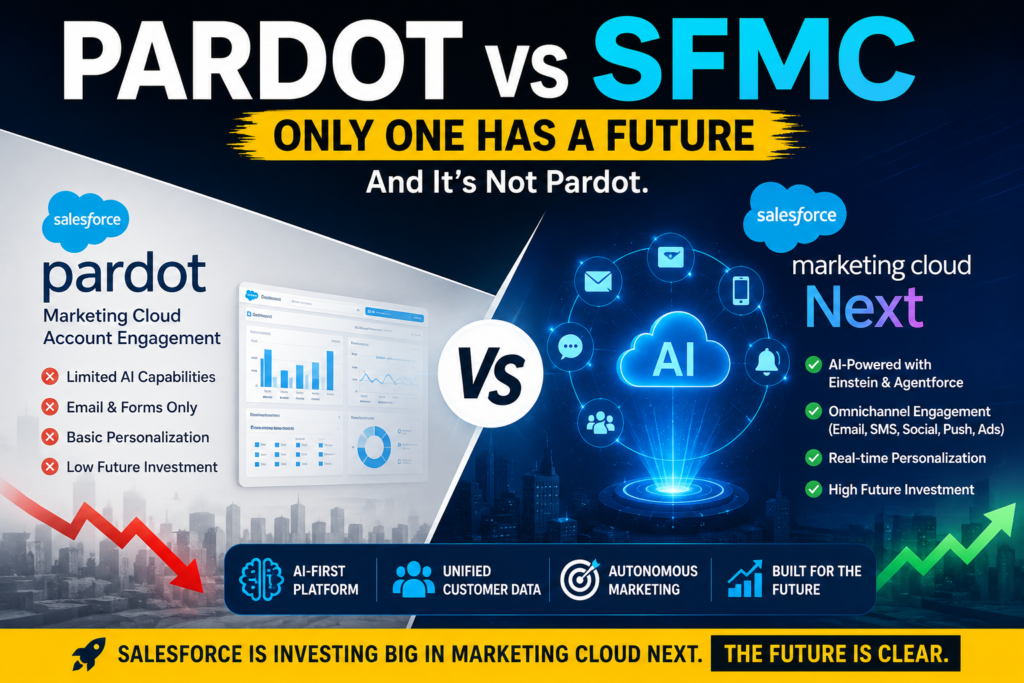
What Are Pardot and SFMC?
Many professionals assume Pardot and SFMC are simply different versions of the same product.
They’re not.
Pardot (Marketing Cloud Account Engagement)
Pardot was designed primarily for B2B companies. Its strengths include:
- Lead capture
- Lead scoring
- Email nurturing
- Form creation
- Salesforce CRM integration
Think of Pardot as a reliable system for managing longer B2B sales cycles.
Salesforce Marketing Cloud (SFMC)
SFMC was designed for customer engagement at scale.
It supports:
- Email marketing
- SMS campaigns
- Push notifications
- Social media engagement
- Advertising audiences
- Customer journeys
For organizations looking to deliver personalized experiences across multiple channels, SFMC offers significantly broader capabilities.

1. The AI Gap Is Growing Wider Every Year
Artificial intelligence is becoming the centerpiece of modern marketing.
Salesforce has heavily integrated AI into Marketing Cloud through:
- Einstein AI
- Predictive segmentation
- Dynamic personalization
- Agentforce AI agents
- Intelligent campaign recommendations
Meanwhile, Pardot’s AI capabilities remain relatively limited.
While it offers Einstein Send Time Optimization and some automation features, it lacks the advanced AI-driven personalization and autonomous marketing capabilities now becoming standard in enterprise marketing.
For marketers planning for the next five years, this difference is becoming increasingly difficult to ignore.
2. Modern Buyers Don’t Live in Email Alone
Today’s customer journey is fragmented.
A prospect may:
- Discover a brand on LinkedIn
- Visit a website
- Watch a webinar
- Click a retargeting ad
- Open an email
- Receive an SMS reminder
SFMC is built for these complex journeys.
Pardot, by comparison, remains heavily focused on email marketing and lead nurturing workflows. While effective for many B2B organizations, it lacks the native omnichannel capabilities available in Marketing Cloud.
As buyer behavior evolves, multi-channel engagement is becoming less of a luxury and more of a necessity.
3. The Technology Foundations Were Never Truly Unified
One of Salesforce’s biggest challenges is historical.
Many users don’t realize that both Pardot and SFMC originated as acquisitions.
- Pardot was acquired in 2012.
- ExactTarget (which became SFMC) was acquired in 2013.
As a result, the two platforms were built on different technical foundations and data models. They connect to Salesforce differently and operate differently behind the scenes.
This architectural complexity may explain why Salesforce appears to be investing more heavily in rebuilding rather than modernizing existing systems.

4. Marketing Cloud Next Changes Everything
Perhaps the strongest signal came in 2025 when Salesforce introduced Marketing Cloud Next.
This wasn’t a simple feature update.
It was presented as a complete reimagining of Salesforce marketing technology, featuring:
- Unified customer data
- Native Salesforce platform integration
- Autonomous AI agents
- One platform for both B2B and B2C marketing
The most interesting part?
Salesforce didn’t position Pardot as the center of this future vision. Instead, the spotlight was firmly on Marketing Cloud Next.
For many industry observers, that spoke volumes.
5. Even the Rebrand Raised Questions
In 2022, Salesforce renamed Pardot to Marketing Cloud Account Engagement.
While the change aligned the product more closely with the Marketing Cloud family, many professionals felt the platform itself remained largely unchanged.
The new name suggested deeper integration, but many of the advanced Marketing Cloud capabilities never arrived in Pardot.
This has led some marketers to view the rebrand as a positioning exercise rather than a major product evolution.

What Does This Mean for Current Pardot Users?
Before anyone panics:
Salesforce has not announced the retirement of Pardot.
The platform remains valuable for:
- B2B lead generation
- Lead nurturing
- Email marketing
- CRM alignment
- Sales and marketing collaboration
For many organizations, it still performs these functions very well.
However, companies evaluating their long-term martech strategy should pay close attention to where Salesforce is directing its innovation investments.
My Perspective as a Marketing Automation Professional
Having worked with marketing automation platforms, one trend is becoming increasingly clear:
The future belongs to platforms that combine:
✅ AI-driven decision making
✅ Real-time personalization
✅ Omnichannel engagement
✅ Unified customer data
✅ Autonomous campaign execution
The question isn’t whether marketing automation will evolve.
The question is whether your current platform is evolving fast enough.
Final Thoughts
Pardot isn’t broken.
It isn’t obsolete.
But the signals coming from Salesforce suggest that its future growth may be limited compared to Marketing Cloud and Marketing Cloud Next.
If your organization only needs straightforward B2B email nurturing, Pardot can continue delivering value.
If you’re planning for an AI-powered future that includes personalization, automation, and cross-channel engagement, it may be time to start evaluating Salesforce’s broader marketing ecosystem.
The Salesforce logo may be the same on both products.
The future investment strategy appears very different.
Check out our SIP investor calcultor pro