
In one of the most significant moments in modern business history, Elon Musk has officially become the world’s first trillionaire following the record-breaking public debut of SpaceX. The historic IPO not only shattered fundraising records but also instantly transformed the landscape of global finance, technology, space exploration, and wealth creation.
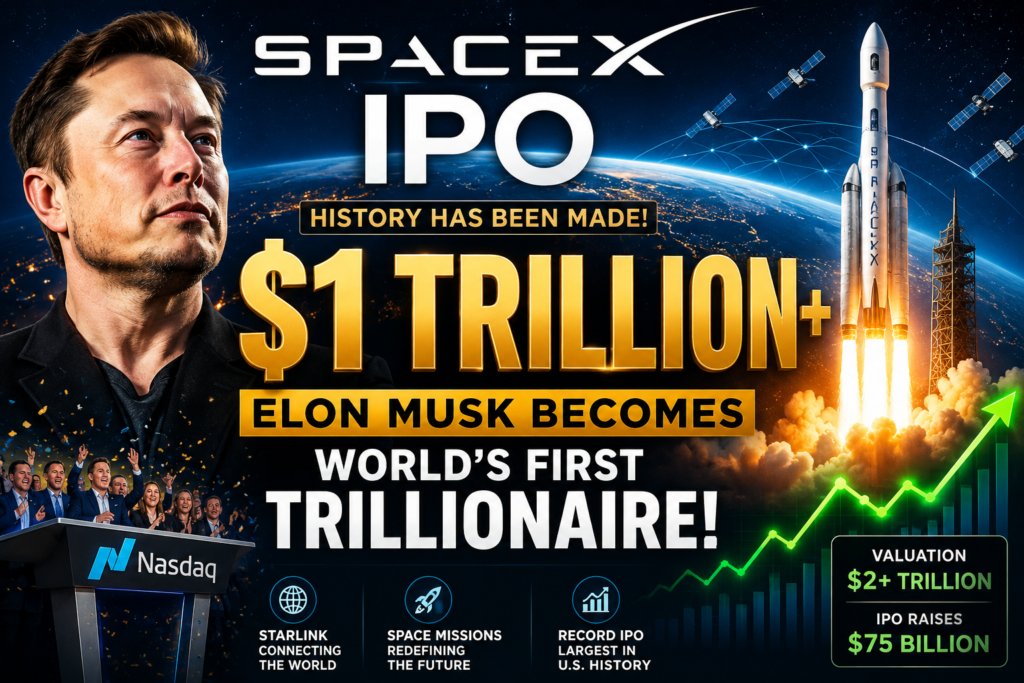
SpaceX went public on June 12, 2026 — and in a single trading day, Elon Musk became the richest human in history. Here’s everything that happened.
A trillion dollars is hard to even picture. Stack one trillion one-dollar bills and you’d have a pile weighing over a million metric tons. On Friday, that number stopped being a thought experiment — and became one man’s net worth.
On June 12, 2026, SpaceX — Elon Musk’s rocket, satellite internet, and AI company — debuted on the US stock market in the largest IPO of all time. By the time markets closed, SpaceX was valued at nearly $2 trillion, and Elon Musk had become the first trillionaire in human history.
This isn’t just a Wall Street story. It’s a story about rockets, satellites, artificial intelligence, and what happens when all three get bundled into a single company and handed to public markets. Here’s the full breakdown.
The Numbers That Made History
Shares opened on Friday at $150 per share, marking an 11% increase from the IPO price of $135, valuing the company at $1.96 trillion and putting SpaceX on track to become the sixth-largest company in the United States. By the close of trading, the stock had surged 18% to $159 per share.
Musk owns roughly four out of every ten SpaceX shares following the IPO — enough to push his net worth from around $780 billion before the listing to over $1 trillion afterward, at least on paper.
Just How Big Is a Trillion Dollars?
As recently as the summer of 2024, Musk, Jeff Bezos, and Bernard Arnault were swapping the title of world’s richest person almost daily, with net worths hovering around $200 billion each. Less than two years later, Musk’s fortune is worth more than double what Bezos and Arnault have combined.
The second-wealthiest person in the world, Google co-founder Larry Page, has a net worth of around $291 billion — meaning Musk is now worth roughly three and a half times more than the world’s #2.
To put it another way: a trillion dollars is roughly equivalent to spending $27 million a day, every day, for a hundred years. Most of us can’t picture a billion dollars, let alone a thousand of them.
How We Got Here: The Road to the Largest IPO Ever
SpaceX was valued at approximately $800 billion, already the world’s most valuable private company.
SpaceX acquired Elon Musk’s AI startup xAI, in a deal reported to value the combined entity at around $1.25 trillion, fusing Starlink’s satellite network with xAI’s AI models for compute, defense, and communications use cases.
SpaceX began preparing for an IPO with plans to raise over $25 billion, targeting a valuation above $1 trillion and potentially as high as $1.5 trillion.
SpaceX went public, raising up to $75 billion in the largest IPO in history — and Musk became the world’s first trillionaire on paper.
The Real Story: This Isn’t Just a Rocket Company Anymore
Here’s the part that’s getting lost in the “first trillionaire” headlines: SpaceX isn’t just a rocket and satellite company anymore — it’s now also a major AI company.
Starlink dominates SpaceX’s revenue at 61% of the total, with space launches contributing 22%. The AI segment — covering X platform advertising, subscriptions, and xAI’s compute infrastructure — adds another 17% following the February 2026 merger.
Starlink delivered $4.4 billion in operating income in 2025 with a 39% operating margin, while the AI division burned $6.4 billion building data centers and training Grok. In short: Starlink is the profit engine that’s now funding Musk’s AI ambitions.
Why does this matter? Because xAI was burning through cash at a rate of roughly $1 billion per month trying to keep pace with Anthropic, OpenAI, and Google — while SpaceX itself was profitable. The merger gave xAI a financial lifeline, and the IPO supercharges it with public market capital.
The “Compute-in-Orbit” Bet
The capital from the IPO is expected to fund space-based data centers that bypass terrestrial power grids and cooling constraints entirely.
Starlink’s closest Western competitor operates roughly 650 satellites generating $216 million in revenue — less than 10% of Starlink’s scale.
SpaceX is marketing a “dual-revenue stream” combining Starlink’s recurring connectivity revenue with an emerging AI-as-a-Service model to Wall Street.
SpaceX’s new Starship V3 has a payload capacity of 100 tons — and would need 10,000 flights just to carry a trillion dollars in cash to orbit.
What This Means — The Excitement and the Risks
- Largest IPO in stock market history
- SpaceX becomes a top-6 US public company on day one
- Public markets now fund both space AND AI ambitions
- Starlink’s dominance gives SpaceX a unique infrastructure moat
- Signals massive investor confidence in space + AI convergence
- Data centers in space remain largely a dream — execution risk is high
- The AI segment burned $6.4 billion in a single year
- Wealth is “on paper” — tied to volatile stock price, not cash
- Concentration of space + AI + social media power in one person
- Between January 2025 and March 2026, the company lost $8.7 billion overall
“While Musk can raise billions by borrowing against his holdings, even the hint that he might sell out of SpaceX, Tesla, or his other companies could be enough to crash their market value overnight.”
— Bloomberg, on the realities of “paper” trillionaire wealthThe Bigger Picture: Why This Matters Beyond One Man’s Net Worth
It’s tempting to treat this as just another billionaire headline. But the SpaceX IPO is really a story about where the next decade of technology infrastructure is headed.
By tying together the Starship heavy-lift rocket program, the Starlink satellite network, and xAI’s compute capabilities, SpaceX is positioning itself as the architect of an entirely new “compute-in-orbit” economy — one that could disrupt the existing hierarchy of terrestrial tech giants competing for AI infrastructure dominance.
Whether or not orbital data centers become reality anytime soon, the message to the market is clear: the next phase of the AI race isn’t just about better models — it’s about who controls the energy, compute, and connectivity infrastructure that AI runs on. And right now, one company just got a $75 billion war chest to go after exactly that.
The Bottom Line
SpaceX’s IPO wasn’t just the largest in history — it was a statement. By merging rockets, satellites, and AI into one publicly traded company, and handing Elon Musk a trillion-dollar fortune in the process, the markets just placed an enormous bet on the convergence of space and artificial intelligence. The technology to back that bet — orbital data centers, AI-as-a-service via satellite — is still mostly aspirational. But the capital is now real, public, and enormous. Whatever happens next, this is a moment the tech and business world will be talking about for years.
💬 What’s your take? Genuinely historic milestone, or a “paper wealth” headline that doesn’t change much day to day? Drop your thoughts in the comments — and if you want my take on how this AI infrastructure race connects to enterprise tools like Salesforce and marketing automation, that’s coming up next.