Trending in Finance
UPI Charges 2026: Stop Falling for the Misinformation Trap
What actually changed. Who pays. Why your money is still safe.
Quick Facts
- ✓ Your UPI is still free — Finance Minister Nirmala Sitharaman confirmed it in Parliament
- ✓ No charges for personal transfers — Sending money to family/friends: completely free
- ✓ Merchant charges only (maybe) — IF implemented, charges would fall on large retailers, not users
- ✓ No rate decided yet — Parliament gave government the power to charge, not the obligation
- ✓ Only 5% of transactions affected — High-value merchant payments above ₹2,000 only
The Controversy: What Happened in August 2026?
If you’ve been scrolling through social media, you’ve probably seen panic posts about UPI charges. Headlines screamed “UPI Will No Longer Be Free,” and your WhatsApp groups erupted with doomsday forwards. But here’s what actually happened—and it’s way less dramatic.
August 6, 2026: Parliament passed the Taxation and Other Laws (Amendment) Bill, 2026, which made a single change: it amended Section 10A of the Payment and Settlement Systems Act to remove the statutory ban on Merchant Discount Rate (MDR) charges for UPI transactions.
Translation: The government removed a legal restriction that prevented it from charging. This is an enabling provision—it gives the government the power to decide later, but makes no actual changes to UPI today.
The Myth vs. Reality Breakdown UPI Charges 2026
❌ Myth: “I have to pay to send money via UPI now”
Reality: Your personal UPI transactions remain completely free. The government has explicitly stated—through the Finance Minister in Parliament—that UPI charges 2026 will stay free for consumers. Period.
❌ Myth: “All merchants will pass charges to customers”
Reality: Charges (if implemented) would only apply to large merchants with annual turnovers exceeding ₹1-1.5 crore and transactions above ₹2,000. Your local vegetable vendor, small shop, or neighborhood restaurant? Unaffected. These big retailers absorb MDR costs as a business expense—just like they do with card payments.
❌ Myth: “Charges start from next month”
Reality: No rate has been decided. The government only changed a rule; it hasn’t implemented anything. The UPI and Services Steering Committee (headed by NPCI) will decide if and when charges happen. Don’t believe forwards with specific charge amounts—they’re speculation.
❌ Myth: “This destroys UPI’s entire model”
Reality: UPI processed 2,366 crore transactions worth ₹29.9 lakh crore in July 2026 alone. It’s become the world’s largest real-time payment system. A narrow MDR on large merchant payments doesn’t destroy this. What it does is help move UPI toward sustainability without relying entirely on government subsidies (currently ₹11,349 crore/year).
Why This Change? The Economics Behind It
Here’s the thing most arguments miss: UPI isn’t free to operate. Someone pays for the infrastructure, cybersecurity, fraud prevention, and technology upgrades. UPI charges 2026
For years, the government subsidized this—and still does. But the costs are growing as UPI scales globally (it’s live in 11 countries and expanding). RBI Governor Sanjay Malhotra put it plainly: “Someone has to bear these costs.”
The three options on the table:
- Status quo: Taxpayers subsidize UPI through annual budget allocations (₹11,349 crore already spent, ₹2,000 crore budgeted for 2026-27)
- Merchant charges: Large retailers contribute via MDR, keeping it free for everyday users
- RBI funding: The central bank uses surplus profits to fund UPI, reducing dividends to the government
Each has tradeoffs. The government is exploring option 2—but this is a policy debate, not a done deal.
Timeline: What Actually Happened (Chronologically) UPI charges 2026
January 2020
Government legally mandated zero MDR on UPI to ensure mass adoption
August 4, 2026
Parliament introduced the Taxation and Other Laws (Amendment) Bill
August 6, 2026
Lok Sabha passed the bill (congressional debate + approval)
August 8, 2026
Government clarified in official statement: “UPI will remain free for consumers”
Now (September 2026)
No charges implemented. Rate-setting process ongoing. Zero impact on user experience.
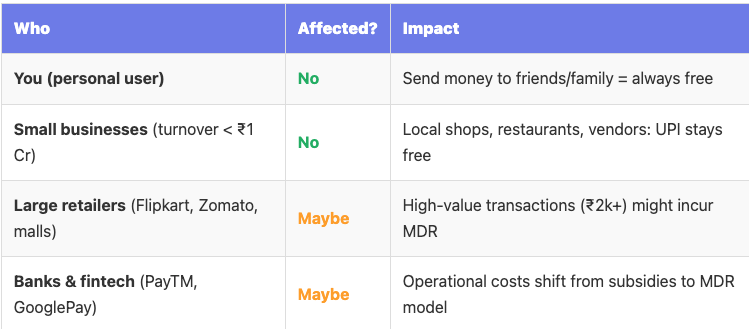
Who Pays? The Impact Calculator
This is important: let’s break down who’s actually affected under the proposed scenario.
| Who | Affected? | Impact |
|---|---|---|
| You (personal user) | No | Send money to friends/family = always free |
| Small businesses (turnover < ₹1 Cr) | No | Local shops, restaurants, vendors: UPI stays free |
| Large retailers (Flipkart, Zomato, malls) | Maybe | High-value transactions (₹2k+) might incur MDR |
| Banks & fintech (PayTM, GooglePay) | Maybe | Operational costs shift from subsidies to MDR model |
Note: This is the proposed scenario. No charges are live yet. The actual impact depends on government + RBI final decision.
The Government’s Official Statement (August 2026) UPI charges 2026
Cut through the noise. Here’s what Finance Minister Nirmala Sitharaman said officially:
“UPI will remain free for consumers. Any charges would be on merchants, not users. The amendment ensures long-term sustainability of the UPI ecosystem without burdening everyday transactions.”
She also clarified: charges (if any) would be significantly lower than credit/debit card MDR rates and would only apply to a small subset of high-value merchant payments.
What You Should Actually Do
Action Items (You Don’t Need Many)
- Keep using UPI normally. Your personal transactions remain free. Nothing changes for you today.
- Ignore panic forwards. If someone shares “UPI charges 2026 from [date],” it’s misinformation. Screenshot the official government statement instead.
- Stay informed, not anxious. Official announcements come from the Finance Ministry or RBI, not Facebook posts.
- Monitor policy updates. If charges are eventually implemented, they’ll be announced 3-6 months in advance with clear details.
The Bigger Picture: Why This Matters for India’s Digital Future
India’s achievement with UPI is extraordinary. It processes more real-time transactions than any country—including the US, China, and Singapore combined. But this success came with a cost: ₹11,349 crore in government subsidies.
As UPI expands globally (now live in 11 countries), the question becomes: how do we keep it running without endless taxpayer funding?
Three scenarios:
- Keep the status quo → Infinite subsidies, but they’re finite. Eventually unsustainable.
- Introduce merchant charges → Large retailers pay, everyday users don’t. Market-based sustainability.
- Let the RBI fund it → Use central bank surplus; less dividend for government but politically easier.
This isn’t a “UPI is dying” moment. It’s a “how do we scale responsibly” moment. That’s actually a good problem to have.
FAQs: The Questions You’re Actually Asking
Q: Do I need to switch payment methods?
No. Your UPI is still the safest, fastest option for personal payments. Nothing changes for you.
Q: Will this make UPI less popular?
Unlikely. UPI’s popularity comes from convenience, not price (it’s always been free). Even if merchant charges are introduced, personal transfers stay free.
Q: When will charges actually start?
Unknown. No date, rate, or implementation plan has been announced. The government only changed the law to allow charging—they haven’t decided to charge yet.
Q: Will my daily shopping payments be charged?
No. Proposed charges apply to high-value merchant transactions (₹2,000+) from large retailers only. Your ₹500 coffee or ₹1,500 grocery run? Free.
Q: Is my UPI account secure?
Yes, completely. This policy change has zero impact on security. Your UPI PIN, biometric authentication, and fraud protection remain unchanged.
The Bottom Line
UPI charges 2026 remains free for you. The government amended a law to enable merchant charging in the future—but made no actual changes to how you use UPI today. Your personal payments, family transfers, and everyday shopping are unaffected.
This isn’t a crisis. It’s a policy discussion about sustainability. Use UPI normally. Ignore panic posts. Stay informed from official sources.
Last Updated: September 2026 | Sources: Finance Ministry, RBI Statements, Parliament Records