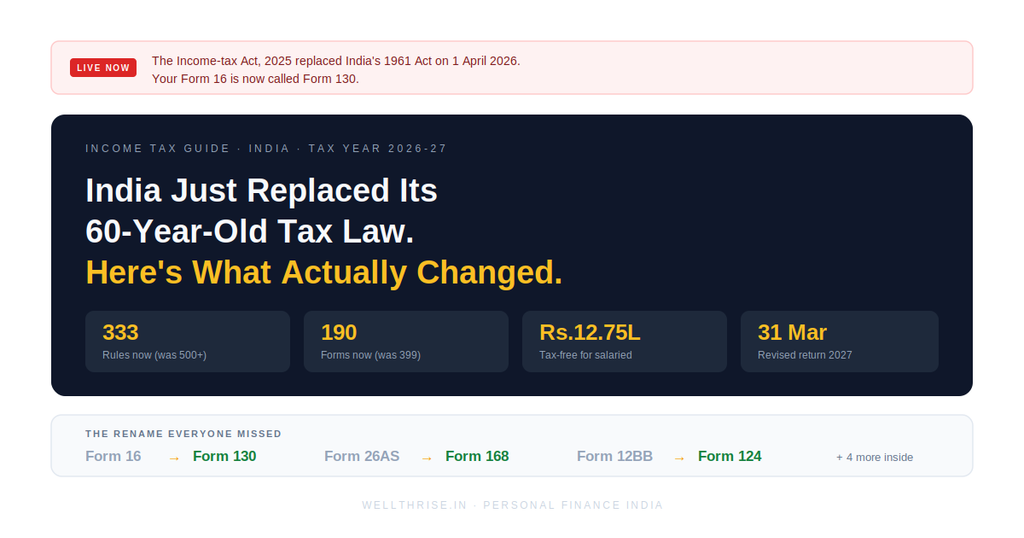
Here’s What Actually Changed.
On 1 April 2026, the Income-tax Act, 1961 — the law that governed every rupee Indians earned for six decades — was retired. In its place: the Income-tax Act, 2025. Most salaried Indians still don’t know their Form 16 has a new name.
The new income tax rules 2026 are not about raising your taxes. Slabs are unchanged. The ₹12 lakh rebate stands. What changed is the machinery — the language, the form numbers, the terminology, and the deadlines. And if you don’t know the new names, you will be confused the moment your employer hands you a document titled Form 130 instead of Form 16.
This guide covers all 12 changes under the new income tax rules 2026 that actually affect salaried employees, freelancers and investors — explained in plain English, with the old-to-new translation table you’ll want to bookmark.
📜 What Exactly Changed on 1 April 2026?
Two things came into force together:
- The Income-tax Act, 2025 — replacing the Income-tax Act, 1961 entirely
- The Income-tax Rules, 2026 — replacing the Income-tax Rules, 1962
The stated goal was simplification. The old Act had accumulated six decades of amendments, provisos and cross-references that even chartered accountants found difficult to navigate. The rewrite cut the rule count from over 500 down to 333, and collapsed 399 forms into 190. You can verify the current position on the official Income Tax Department portal.
- 500+ rules, 399 forms
- “Financial Year” + “Assessment Year”
- Form 16, Form 26AS, Form 12BB
- Dense legal drafting, heavy cross-referencing
- Revised return window: 31 December
- 333 rules, 190 forms
- Single term: “Tax Year”
- Form 130, Form 168, Form 124
- Plain-language drafting, tables over prose
- Revised return window: 31 March
📄 Form 16 Is Now Form 130 — The Complete Renaming Table
This is the change that will confuse the most people. Under the new income tax rules 2026, the familiar form numbers everyone memorised over decades have been renumbered to align with the new Act’s section structure.
The contents are identical. Only the labels changed. Here is the full translation:
| What It Does | Old Number | New Number |
|---|---|---|
| TDS certificate on salary | Form 16 | Form 130 |
| TDS certificate (non-salary) | Form 16A | Form 131 |
| Annual Information Statement | Form 26AS | Form 168 |
| Quarterly TDS return (salary) | Form 24Q | Form 136 |
| Quarterly TDS return (non-salary) | Form 26Q | Form 140 |
| Quarterly TDS return (non-residents) | Form 27Q | Form 144 |
| Employee investment declaration | Form 12BB | Form 124 |
Old form names remain valid for all periods before 1 April 2026. Your Form 16 for FY 2025-26 (which you use to file this year) is still called Form 16. The first Form 130 you receive will be in mid-2027, covering Tax Year 2026-27.
📅 “Tax Year” Replaces Financial Year and Assessment Year
Every Indian taxpayer has spent years mentally juggling two overlapping periods: the Financial Year in which income was earned, and the Assessment Year in which it was taxed. The new income tax rules 2026 collapse both into a single term.
Under the new income tax rules 2026, income you earn from April 2026 onwards is simply reported under Tax Year 2026-27. No second label. No mental arithmetic.
💰 Do the Tax Slabs Change? (No — Here’s the Reality)
This is the single most common misunderstanding. A new Act sounds like new rates. It isn’t.
| Item | Status Under New Rules |
|---|---|
| Income tax slabs | Unchanged |
| Basic exemption limit (new regime) | ₹4 lakh — unchanged |
| Rebate threshold | ₹12 lakh — still nil tax |
| Standard deduction (salaried) | ₹75,000 — unchanged |
| Effective tax-free income (salaried) | ₹12.75 lakh |
| Old regime availability | Still available if you opt in |
| Default regime | New regime remains default |
| Securities Transaction Tax | Increased — affects F&O traders |
If you are a salaried employee earning under ₹12.75 lakh, your tax liability is unchanged at zero under the new regime. The new income tax rules 2026 changed the wrapper, not the arithmetic.
⏳ Deadlines Have Changed — And One Is Genuinely Good News
The Finance Act, 2026 introduced a staggered deadline structure. For the first time, non-audit business and professional taxpayers get an extra month compared to salaried filers.
Unchanged from previous years. Applies to most salaried taxpayers with income from salary, one or two house properties, and other sources.
A permanent change under the Finance Act, 2026 — not a one-off extension. Freelancers, consultants, doctors, lawyers and small business owners get an extra month.
Businesses requiring a tax audit must submit Form 3CA/3CB/3CD by this date, one month before their ITR deadline.
Miss your original deadline and you can still file a belated return until this date — with a late fee of ₹1,000 (income up to ₹5 lakh) or ₹5,000 (above ₹5 lakh).
Previously 31 December. Now extended by three months, giving taxpayers substantially more time to correct genuine errors or claim missed deductions.
Say you filed in June 2026 and realised in January 2027 that you forgot to claim ₹1.5 lakh under Section 80C. Under the old rules, the 31 December window had already closed — that deduction was gone.
Under the new income tax rules 2026, you can file a revised return up to 31 March 2027 and recover roughly ₹46,800 in tax (at the 30% slab plus cess). No penalty. This one change alone justifies knowing the new deadlines.
📋 ITR-1 Now Covers Two House Properties
A small change with meaningful reach. Until AY 2025-26, owning more than one house property forced you into the considerably more complex ITR-2.
From AY 2026-27, ITR-1 (Sahaj) can report income from up to two house properties. For a large number of middle-class taxpayers who own a self-occupied home plus a let-out flat, this means staying on the simple one-page form instead of graduating to ITR-2.
🔄 Updated Returns (ITR-U) Can Now Carry Forward Losses
Previously, if you filed an updated return under ITR-U, you lost the ability to carry forward losses — which discouraged voluntary compliance. The new income tax rules 2026 removed that restriction.
Losses declared in updated returns can now be carried forward, subject to conditions. For anyone with capital losses from equity or F&O trading who filed late, this is a substantial change.
From 1 April 2026, you can no longer file updated returns for FY 2020-21 (AY 2021-22). That window is shut. Penalties for updated returns covering FY 2021-22 through FY 2024-25 have also been revised upward on a sliding scale.
🏠 HRA and Allowance Limits Finally Updated for Inflation
One of the more overdue corrections. Exempt allowance limits and perquisite valuations under the old rules had not kept pace with inflation for years — making many exemptions functionally meaningless.
The new income tax rules 2026 reset these to reflect current market rates. Additionally, the list of cities eligible for higher HRA exemption has been expanded, benefiting salaried employees in tier-2 cities who were previously excluded.
If you are weighing how much your money actually buys today versus a decade ago, our breakdown of how inflation has reshaped the cost of living in India puts these allowance revisions in context.
📊 Every Change at a Glance
| # | Change | Who It Affects | Impact |
|---|---|---|---|
| 1 | Income-tax Act, 2025 replaces 1961 Act | Everyone | Structural |
| 2 | Form 16 → Form 130 | Salaried | Label only |
| 3 | Form 26AS → Form 168 | Everyone | Label only |
| 4 | Form 12BB → Form 124 | Salaried | Label only |
| 5 | “Tax Year” replaces FY + AY | Everyone | Simplification |
| 6 | Rules cut 500+ → 333 | Everyone | Simplification |
| 7 | ITR-3/ITR-4 deadline → 31 Aug | Freelancers, professionals | More time |
| 8 | Revised return → 31 March | Everyone | More time |
| 9 | ITR-1 covers 2 house properties | Property owners | Simpler filing |
| 10 | ITR-U can carry forward losses | Investors, traders | Tax saving |
| 11 | HRA and allowance limits updated | Salaried | Higher exemption |
| 12 | Securities Transaction Tax increased | F&O traders | Higher cost |
✅ What You Should Actually Do
1. Bookmark the form translation table above. When your employer hands you Form 130 in mid-2027, you will not waste an afternoon wondering what happened to Form 16.
2. Check whether ITR-1 now covers you. If you own two properties and were filing ITR-2 purely for that reason, you may be able to move back to the simpler form.
3. Review last year’s return for missed deductions. With the revised return window now open until 31 March 2027, a forgotten 80C or 80D claim is still recoverable.
4. If you trade F&O, recalculate your costs. The STT increase changes the arithmetic on high-frequency strategies.
5. Confirm your payroll provider is ready. Payroll software must generate Form 130, not Form 16, for Tax Year 2026-27 onwards.
❓ Frequently Asked Questions
The Bottom Line
The new income tax rules 2026 represent India’s most significant tax restructuring since 1961 — but the restructuring is administrative, not financial. Your slab did not move. Your rebate did not shrink. What changed is the vocabulary: Form 16 became Form 130, Form 26AS became Form 168, and Financial Year plus Assessment Year collapsed into a single Tax Year.
Two changes are genuinely valuable and worth acting on: the revised-return deadline moving to 31 March gives you three extra months to recover missed deductions, and the ITR-3/ITR-4 extension to 31 August gives freelancers and professionals real breathing room.
The practical risk is confusion, not cost. Taxpayers who do not know the new form numbers will lose time, file under the wrong period, or miss a deduction they were entitled to. Learn the translation table, note the new deadlines, and the transition is straightforward.
💬 Confused about which form or deadline applies to you? Drop your situation in the comments and we will point you to the right one. If this guide saved you a search, share it with someone who still thinks their Form 16 is called Form 16. 📝
Disclaimer: This article is for informational purposes only and does not constitute tax or financial advice. Form renumbering and rule details are based on CBDT notifications and Income-tax Rules, 2026 as available at the time of writing. Verify all form numbers and deadlines against the official Income Tax e-filing portal or consult a qualified chartered accountant before filing.