RBI repo rate hikes to 5.50%: what it means for your EMI and FD
The RBI repo rate has gone up for the first time in over three and a half years. Here’s what changed, why, how much more you’ll pay on your home loan, and what to do with your fixed deposits.
⚡ The 30-second version
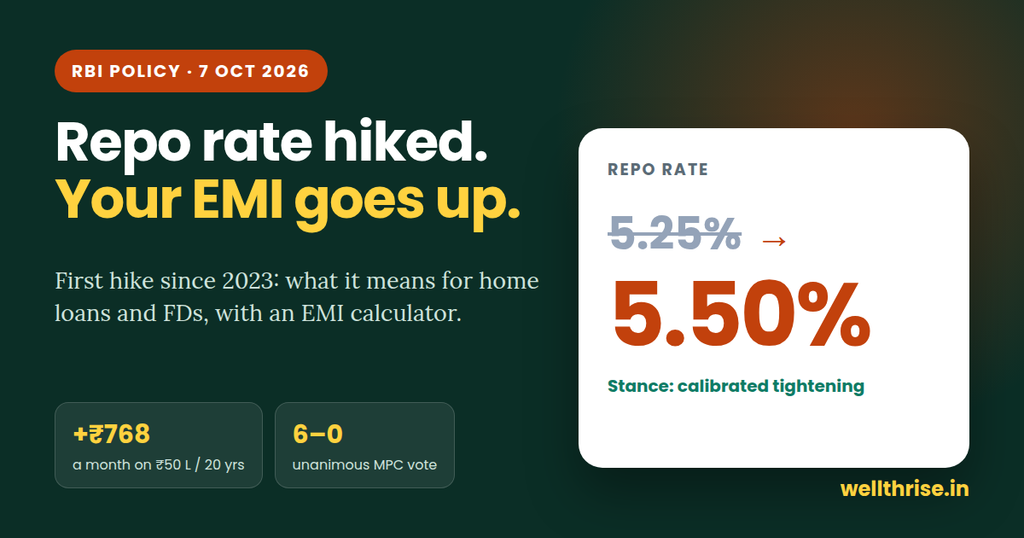
- The RBI’s Monetary Policy Committee raised the RBI repo rate by 25 basis points to 5.50% on 7 October 2026. All six members voted for it.
- It changed its stance from neutral to calibrated tightening. Governor Sanjay Malhotra said a rate cut is unlikely in the near term: the next move is either a hike or a pause.
- Floating-rate home loans will cost more, usually from your loan’s next reset date. On a ₹50 lakh, 20-year loan that’s roughly ₹770 more a month.
- FD rates should rise. Several economists expect one more hike in December, so don’t lock all your money in at once.
01 · The decisionRBI repo rate and policy rates: what changed
| Rate | Before | From 7 Oct 2026 |
|---|---|---|
| Repo rate (what banks pay RBI) | 5.25% | 5.50% ▲ |
| Standing Deposit Facility (SDF) | 5.00% | 5.25% ▲ |
| Marginal Standing Facility (MSF) | 5.50% | 5.75% ▲ |
| Bank rate | 5.50% | 5.75% ▲ |
| Policy stance | Neutral | Calibrated tightening |
The policy meeting ran from 5 to 7 October. The RBI repo rate is the benchmark that most new home loans in India are linked to, so this number flows almost directly into your EMI.
02 · The reasonWhy the RBI repo rate went up now
In short: prices are rising faster, the rupee is weak, and the economy is strong enough to take a small hike. The RBI pointed to broadening price pressures and supply shocks.
A weaker rupee makes oil, gold and electronics costlier, which feeds inflation. Raising rates makes holding rupees more attractive and cools demand a little.
03 · The cycleRBI repo rate history since 2023
The RBI repo rate was cut four times in 2025, by a total of 125 basis points, and then held at 5.25% for four straight meetings. Today’s hike reverses part of that.
04 · Your loanRBI repo rate hike EMI calculator: how much more will you pay?
Estimates only. Your bank decides the reset date and whether it raises your EMI or extends your tenure, so check your loan statement or app.
05 · Your moneyWhat changes for loans, FDs and savings
| Product | What happens | When |
|---|---|---|
| Repo-linked (EBLR) home loans | Rate rises by about 0.25% | At your next reset, usually within 3 months |
| MCLR-linked loans | Rises gradually as banks revise MCLR | Over a few months, at your reset date |
| Fixed-rate car and personal loans | Existing EMIs don’t change; new loans get costlier | New loans: soon |
| New fixed deposits | Rates likely to rise | Days to weeks |
| Existing FDs | No change: your rate is locked until maturity | n/a |
| Debt mutual funds | Bond prices dip as yields rise; future returns improve | Immediately |
Before the hike, 1–2 year FD rates averaged about 6.60% at public-sector banks and 7.00% at private banks, with some small finance banks offering up to 8.10%. SBI’s FD rates ranged from 3.05% to 6.40% for regular customers, and HDFC Bank’s from 2.75% to 6.50%.
06 · What to doYour next steps
🏠 You have a floating-rate home loan
Check your reset date in your bank app. If you have spare cash, a part-prepayment now saves more interest than before. If your bank extends your tenure instead of raising the EMI, ask to raise the EMI: a longer loan costs far more in total.
🆕 You’re about to take a loan
Compare the spread over repo, not just today’s rate: that spread stays fixed for your whole loan. A lower spread beats a teaser rate.
💰 You’re putting money in an FD
Don’t lock everything into a 5-year FD today. With another hike possible in December, split it: some now in 1–2 year FDs, the rest after banks revise rates. This is called an FD ladder.
📊 You hold debt funds
A small short-term dip in value is normal when rates rise. Don’t panic-sell; higher yields mean better returns from here if you stay invested.
07 · What’s nextWill the RBI hike again?
The Governor has taken rate cuts off the table for now. Before today’s meeting, SBI Research and Goldman Sachs both forecast a second 25 bps hike in December, which would take the RBI repo rate to 5.75%. Whether that happens depends on September and October inflation figures and on crude oil and the rupee. The next policy meeting is in early December.
FAQCommon questions
What is the new RBI repo rate?
The RBI repo rate is now 5.50%, up from 5.25%, effective 7 October 2026.
Will my home loan EMI go up immediately?
Not on the same day. Repo-linked loans usually change at the next reset date, which banks typically set quarterly. Your bank will inform you, or you’ll see it in your loan statement.
How much will my EMI increase?
Roughly ₹15 per month for every ₹1 lakh of a 20-year loan at around 7.5%. Use the calculator above for your exact figures.
Should I book an FD now or wait?
Split it. Put part of your money in now and keep part for after banks raise rates, especially if another hike comes in December.
When was the last time the RBI raised rates?
February 2023, when the RBI repo rate went to 6.50%. It then stayed there for two years before the 2025 cuts.
Keep readingRelated on Wellthrise
Sources: Business Standard · Upstox live updates · Business Today · Goodreturns · Paterson Capital. Educational content, not financial advice.