
Morning coffee sirf neend bhagane ke liye hai… ya your daily cup could actually be doing something good for your health too?
For many of us, coffee is less of a beverage and more of a survival strategy.
Monday morning? Coffee.
Long meeting? Coffee.
Post-lunch sleepiness? Coffee.
Someone messages “Can we quickly connect?”
Definitely coffee. 😂
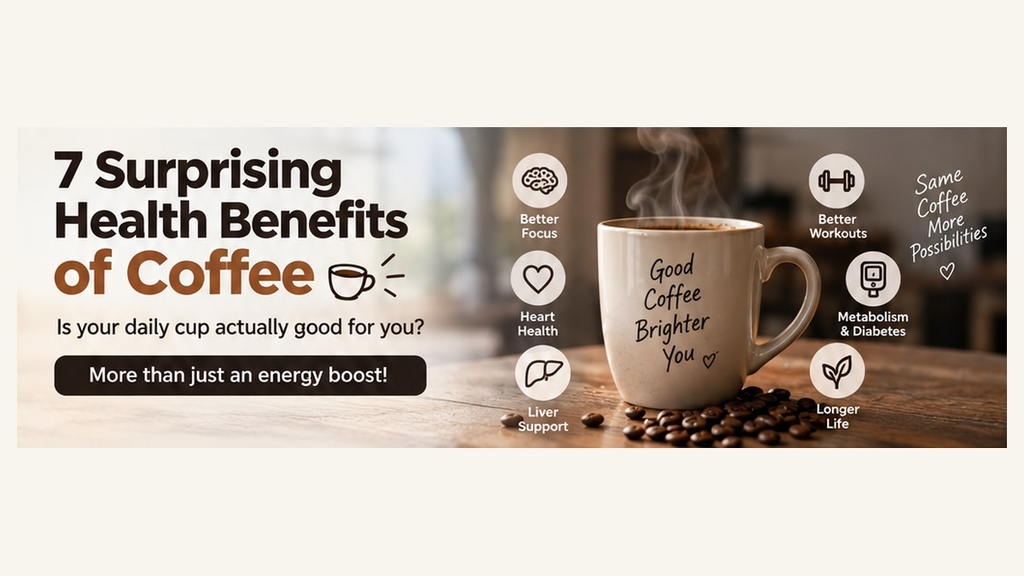
But jokes apart, coffee is one of the most widely studied beverages in the world. Research has linked moderate coffee consumption with several interesting health outcomes — from better alertness and exercise performance to possible benefits involving heart health, liver health, type 2 diabetes and even longevity.
Before you celebrate by ordering an extra-large caramel coffee with whipped cream though…
Coffee can be healthy. Your coffee order may be a different story. 😭
Share
1. Coffee Can Improve Alertness and Mental Focus 🧠⚡
This is probably one of the health benefits of coffee you’ve already experienced yourself.
The main reason is caffeine.
Caffeine stimulates the central nervous system and can temporarily make you feel more awake, alert and focused.
Basically, that first cup can sometimes feel like your brain has finally finished installing its morning software update.
Before coffee:
“Why is this Excel sheet attacking me?”
After coffee:
“Send me the data. I’ll handle it.” 😎☕
But more caffeine doesn’t automatically mean better concentration.
Too much caffeine can cause restlessness, anxiety, shaky hands, palpitations or sleep problems in some people. The American Heart Association’s 2026 review also notes that responses to caffeine vary considerably between individuals.
So the goal is simple:
Alert hona hai. Wi-Fi router ki tarah vibrate nahi karna. 😂

Share
2. Coffee Is Much More Than Just Caffeine 🫘
Most of us think:
Coffee = caffeine.
Not exactly.
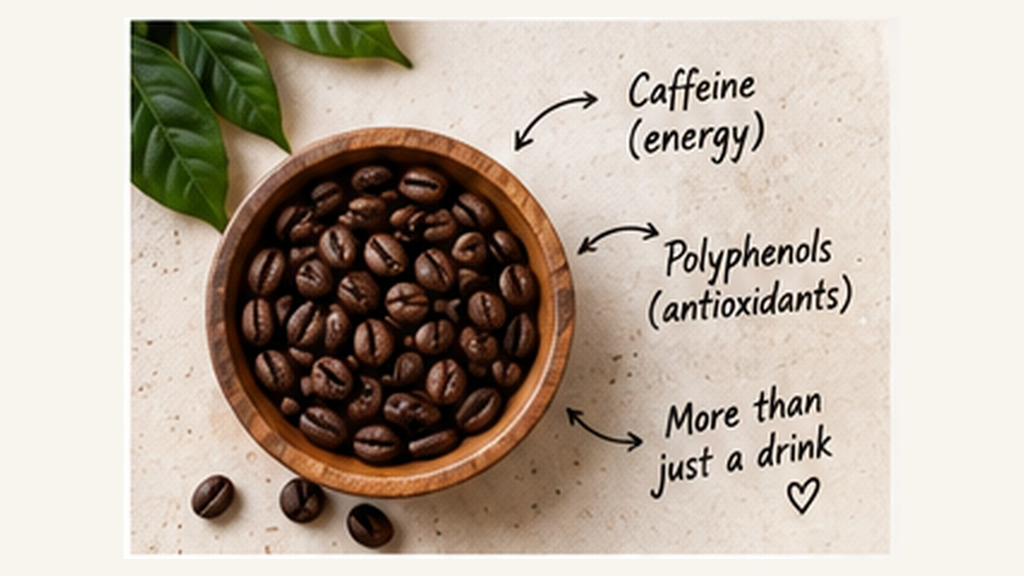
Coffee contains numerous naturally occurring compounds, including polyphenols and other biologically active substances.
That’s one reason researchers don’t study coffee simply as an energy drink.
A major umbrella review published in The BMJ examined more than 200 meta-analyses and found that coffee consumption was more often associated with health benefit than harm across the outcomes studied. Researchers were careful to point out, however, that much of the evidence was observational — meaning it can’t prove coffee itself caused those benefits.
Translation:
Coffee looks interesting.
But…
Coffee ≠ magic medicine.
“Antioxidants hain” sunke 6 cups pe jaana scientific strategy nahi hai. 😂
Your overall diet, exercise, sleep and lifestyle still matter far more than any single beverage.
Share
3. Coffee May Be Linked With Better Heart Health ❤️
For years, coffee had a slightly bad reputation when it came to the heart.
After all, caffeine can temporarily affect blood pressure and heart rate.
But the current picture is much more nuanced.
According to the American Heart Association’s 2026 scientific review, up to around 400 mg of caffeine per day is considered safe for most adults, and moderate caffeinated coffee consumption does not appear to increase cardiovascular risk for most people.
Some research has even found coffee consumption to be associated with lower risks of certain cardiovascular outcomes.
But there’s one big catch.
Researchers are studying coffee.
Not necessarily your:
Hazelnut + caramel + chocolate + whipped cream + 3 pumps of syrup + coffee hiding somewhere underneath. 😂
The ingredients added to your coffee matter too.
So yes:
Coffee + regular movement + decent food + good sleep = 👍
But:
Coffee + zero exercise + poor sleep + unlimited sugar =
Coffee is working overtime, bhai. 😭
Share
4. Coffee Before Workout? There Is Actually Some Science Behind It 🏋️☕
Ever wondered why caffeine is present in so many pre-workout supplements?
Because caffeine can improve several aspects of exercise performance.
An umbrella review of 21 meta-analyses found that caffeine could improve aerobic endurance, muscular endurance, strength, power and exercise speed, although the size of the effect varies between people and types of exercise.
So technically, you don’t always need a fluorescent ₹3,000 pre-workout tub.
For someone who tolerates caffeine well, a normal cup of coffee before training can sometimes provide the caffeine boost they’re looking for.
But timing matters.
Imagine:
Gym performance: +10
Sleep quality because you had coffee at 8 PM: -25
Net result?
Math is not mathing. 😂
If you work out late at night and caffeine affects your sleep, that performance boost may not be worth the trade-off.
Share
5. Coffee and Liver Health Have an Interesting Relationship 🫀
This is one of the lesser-known health benefits of coffee.
Coffee research has repeatedly found favourable associations involving liver health.
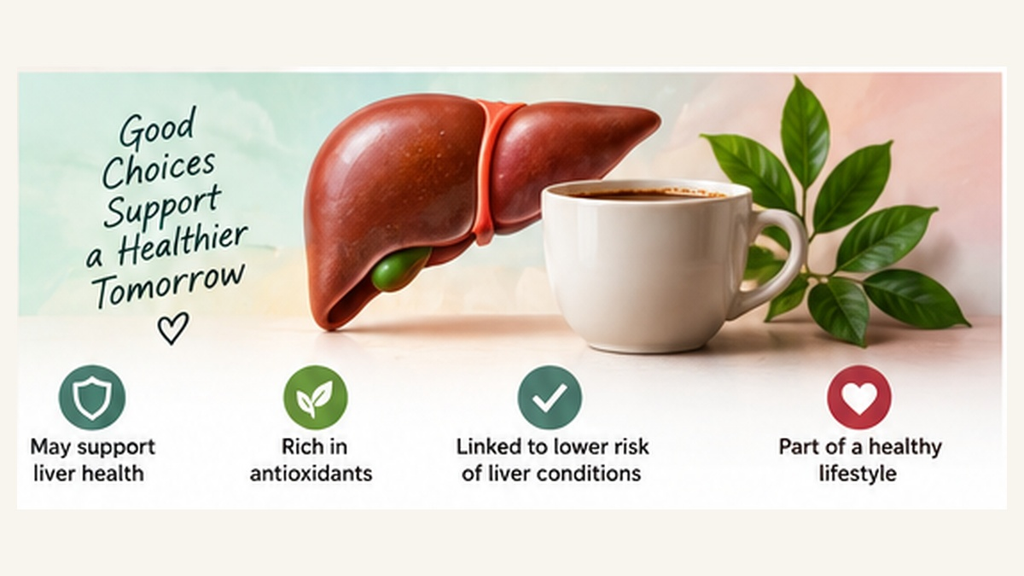
The major BMJ umbrella review found coffee intake was associated with lower risks for several liver-related outcomes, including chronic liver disease and cirrhosis.
But notice the wording carefully:
“Associated with.”
Not:
“Coffee detoxes your liver.”
Your liver already knows how to detox your body.
₹799 Instagram detox powder ki zarurat nahi hai. 😂
And please don’t interpret this section as:
“Coffee liver ke liye achhi hai, toh weekend ka बाकी lifestyle automatically cancel.”
Unfortunately, the human body doesn’t work like credit-card cashback.
Share
6. Coffee Consumption Has Been Linked With Lower Type 2 Diabetes Risk
This one surprises a lot of people.
Large observational studies have repeatedly found an association between habitual coffee consumption and a lower risk of developing type 2 diabetes.
One major systematic review included more than 1.1 million participants and found an inverse relationship between coffee consumption and type 2 diabetes risk.
Interestingly, this association was seen with both caffeinated and decaffeinated coffee.
That suggests caffeine may not be the whole story.
Other compounds naturally present in coffee could potentially contribute too.
But again:
Coffee does NOT “prevent diabetes.”
And this research definitely doesn’t mean:
“Coffee diabetes risk kam karti hai, toh 4 spoon sugar daal dete hain.” 😂
Which brings us to something extremely important…
Your Coffee May Be Healthy. Your Coffee Order May Not Be. 🍬☕
There is a huge difference between:
Coffee + little milk
and
Coffee + sugar syrup + chocolate + caramel + whipped cream + more syrup because apparently the first syrup was lonely.
😂
Black coffee isn’t compulsory.
If you enjoy milk coffee, that’s perfectly reasonable for most people.
The bigger issue is when coffee slowly becomes a daily liquid dessert.
A sweet café drink once in a while?
Enjoy it.
But don’t take a research headline saying “coffee may have health benefits” and automatically apply it to every 500-calorie coffee-flavoured dessert.
Same coffee bean. Very different final drink.
7. Coffee Has Even Been Associated With Longer Life ⏳❤️
Now we arrive at everyone’s favourite headline:
“Drink Coffee and Live Longer!”
Sounds fantastic.
Science is unfortunately less dramatic.
Large observational studies and reviews have repeatedly found an association between moderate coffee consumption and lower all-cause mortality.
The BMJ umbrella review found the largest relative reductions for several outcomes around three to four cups per day versus no coffee, although the researchers stressed that randomized trials would be required to determine whether coffee itself causes these benefits.
So the accurate version is:
✅ Coffee consumption has been associated with longevity.
Not:
❌ Buy coffee. Become immortal.
Sorry. 😭
Morning Coffee May Have Another Advantage ☀️☕
An interesting study published in the European Heart Journal looked at 40,725 U.S. adults and compared coffee-drinking patterns.
Researchers identified people who mainly drank coffee in the morning and people who drank coffee throughout the day.
Compared with people who didn’t drink coffee, the morning coffee pattern was associated with lower all-cause and cardiovascular mortality, while the all-day pattern wasn’t significantly associated with the same reduction.
Again — this was observational research, so it doesn’t prove morning coffee causes longer life.
But the finding raises an interesting point:
Maybe it’s not only how much coffee you drink.
When you drink it may matter too.
The Corporate Coffee-Sleep Cycle 😂🌙
Now let’s discuss the real Indian corporate problem.
9 AM: Coffee because you’re sleepy. ☕
2 PM: Coffee because lunch made you sleepy. ☕
5:30 PM: Coffee because “bas ek last call hai.” ☕
12:30 AM:
“Yaar neend kyun nahi aa rahi?” 👀
Next morning?
Coffee because you didn’t sleep properly.
Congratulations.
You’ve unlocked:
The Corporate Caffeine Loop™ 🔁😂
Caffeine can remain active in your system for hours.
So for people who are sensitive to it:
Poor sleep → more coffee → later caffeine → poorer sleep → more coffee.
At some point, you need to ask:
Is coffee fixing your tiredness… or just temporarily hiding it?
What Is the Best Time to Drink Coffee? ⏰
Internet par you’ll find very specific claims:
“Never drink coffee before 9:37 AM.”
“Exactly 90 minutes after waking up.”
Reality is less dramatic.
There is no universal magical clock time proven to work for every person.
Your caffeine sensitivity, wake-up time and bedtime all matter.
A practical rule is:
If late coffee affects your sleep, move it earlier.
And given the interesting morning-coffee research, keeping most caffeine in the earlier part of the day may be a reasonable habit for many people.
You don’t need to optimize every sip like you’re preparing for the Olympics.
How Much Coffee Is Too Much? ☕☕☕
Here’s where counting cups gets tricky.
A “cup” of instant coffee at home may contain much less caffeine than a strong café brew or double espresso.
That’s why caffeine intake is more useful than simply counting mugs.
The American Heart Association’s 2026 review says intake of up to 400 mg caffeine per day is generally considered safe for most healthy adults.
But please understand:
400 mg is an upper guideline.
It is NOT a daily target. 😂
Don’t read:
“Up to 400 mg is generally safe.”
and think:
Challenge accepted.
One person may comfortably drink three coffees.
Another drinks one strong coffee at 4 PM and at 1 AM is lying in bed calculating:
“Agar 2012 mein Bitcoin khareeda hota toh…” 👁️👁️
Your individual response matters.
Black Coffee vs Milk Coffee: Which Is Better?
The internet loves turning every simple food choice into a competition.
“Only black coffee is healthy.”
Relax. 😂
Black coffee generally has very few calories when nothing is added.
But adding some milk doesn’t automatically make coffee unhealthy.
For most people, more useful questions are:
How much added sugar are you consuming?
How many coffees do you drink?
How much total caffeine are you getting?
Is coffee interfering with sleep?
Does it trigger acidity, anxiety or palpitations?
Those questions matter much more than earning a:
“BLACK COFFEE WARRIOR 💪” badge.
If you like coffee with milk…
Drink your milk coffee.
Healthy habits need to be sustainable.
Is Instant Coffee Healthy?
Good news for the average Indian kitchen.
You do not need a ₹60,000 Italian espresso machine to drink coffee. 😂
Instant coffee is still coffee.
It contains caffeine and coffee-derived compounds.
So your ₹5 sachet doesn’t automatically lose the wellness battle against a ₹350 café Americano.
Your wallet may actually be healthier too. 😭
Again, what matters more is:
Your total caffeine.
Added sugar.
Timing.
And how your body responds.
Quick Coffee Reality Check 🤔
Before grabbing cup number three, ask yourself:
“Am I drinking coffee because I enjoy it… or because I’m permanently exhausted?”
If your answer is:
“I love coffee.”
Great. ☕❤️
But if it’s:
“I slept at 2 AM, woke up at 7 AM and this is coffee number four…”
Then coffee probably isn’t the main problem.
Coffee can temporarily mask tiredness.
It cannot turn 5 hours of sleep into 8 hours.
Sadly, Sleep Replacement Cappuccino™ hasn’t been invented yet. 😂
The Wellthrise Coffee Formula ☕❤️
Making your coffee habit healthier doesn’t require some billionaire’s biohacking routine.
Keep it simple.
☀️ Prefer earlier caffeine if late coffee affects your sleep.
☕ Keep it moderate. More isn’t automatically better.
🍬 Watch added sugar. Coffee shouldn’t unknowingly become dessert three times a day.
🏃 Use caffeine strategically if you enjoy it before exercise.
😴 Protect your sleep. Coffee can help alertness; it can’t replace recovery.
👂 Listen to your body. If caffeine makes you anxious, restless or uncomfortable, don’t ignore it just because a study says coffee can be healthy.
Most importantly:
Don’t turn wellness into another stressful job.
No ₹17 crore longevity protocol required.
No Himalayan coffee beans harvested at exactly 4:37 AM required.
Bas coffee ko coffee rehne do. 😂
Final Sip: Is Coffee Actually Good for You?
So after all this research, should you feel guilty about your morning coffee?
For most healthy adults consuming moderate amounts?
Probably not.
Coffee consumption has been associated with favourable outcomes involving cardiovascular health, type 2 diabetes, liver health and overall mortality, while caffeine itself can improve alertness and aspects of exercise performance. But many of coffee’s long-term health findings come from observational research, meaning they shouldn’t be turned into guarantees.
Coffee isn’t medicine.
Coffee isn’t a replacement for sleep.
Coffee isn’t permission to skip exercise.
And coffee definitely won’t undo an otherwise unhealthy lifestyle.
The boring wellness formula still wins:
Sleep well. Move regularly. Eat reasonably well. Manage stress. Stay connected with people you care about.
And if a cup of coffee makes your morning a little happier?
Enjoy the damn coffee. ☕😂❤️
Frequently Asked Questions About Coffee
Is drinking coffee every day healthy?
For many healthy adults, moderate coffee consumption can fit comfortably into a healthy lifestyle. Research has associated habitual coffee intake with several favourable health outcomes, although individual caffeine tolerance varies.
What is the best time to drink coffee?
There is no universal perfect time for everyone. Earlier-day coffee may be preferable if afternoon or evening caffeine interferes with your sleep.
How much caffeine is safe per day?
For most healthy adults, current American Heart Association guidance considers up to about 400 mg of caffeine per day generally safe, although individual sensitivity can vary.
Can coffee improve workouts?
Caffeine has been shown to improve several aspects of exercise performance, particularly endurance, although the magnitude of benefit differs between individuals.
Is black coffee better than milk coffee?
Black coffee has fewer calories on its own, but adding some milk doesn’t automatically make coffee unhealthy. Excess added sugar, flavoured syrups and large high-calorie toppings are usually more relevant.
Can coffee help you live longer?
Observational research has found associations between coffee consumption and lower all-cause mortality, but this doesn’t prove that drinking coffee directly increases lifespan.
Should non-coffee drinkers start drinking it for health?
No. You don’t need to start drinking coffee just because studies have reported health associations. Coffee can be part of a healthy lifestyle; it isn’t required for one.
Medical Disclaimer
This article is intended for general educational and wellness information only and does not replace professional medical advice. Caffeine sensitivity varies between individuals. Pregnancy, certain health conditions and medications may require different caffeine limits. Speak with a qualified healthcare professional if coffee regularly causes palpitations, severe anxiety, digestive problems or sleep disturbances.