
Old vs new tax regime calculator: see which one saves you more, in 2 minutes.
Enter your salary and the deductions you actually claim. We calculate your tax under both regimes, line by line, and tell you how much extra you’d need to invest for the old regime to win.
- Budget 2026 didn’t change any slabs. In the new regime, salary up to ₹12.75 lakh is effectively tax-free (₹12 lakh rebate limit + ₹75,000 standard deduction).
- The old regime wins only if your deductions are large. At a ₹20 lakh salary you’d need roughly ₹7 lakh of deductions (HRA, 80C, home loan interest and so on) just to break even.
- Above about ₹24 lakh, the break-even point is about ₹8 lakh of deductions, and it stays there.
Old vs New Tax Regime calculator
For salaried residents. Your numbers stay in your browser. Nothing is saved or sent anywhere.
🏠 I pay rent and get HRA
❤️ Health insurance (80D)
🏦 NPS and other deductions
See the full calculation, line by line
| Item | New regime | Old regime |
|---|
Includes 4% health and education cess, the Section 87A rebate with marginal relief, and surcharge with marginal relief above ₹50 lakh. Assumes a resident individual with salary income. Capital gains, business income and special-rate income are not covered.
Tax slabs for 2026-27, side by side (Old vs New Tax Regime)
Budget 2026 kept both slab structures exactly as they were in 2025-26. Under the new Income-tax Act, 2025, which took effect on 1 April 2026, the year is now called the “tax year” instead of “financial year” and “assessment year”, but the rates are the same.
| New regime (default) | Rate |
|---|---|
| Up to ₹4 lakh | Nil |
| ₹4 – 8 lakh | 5% |
| ₹8 – 12 lakh | 10% |
| ₹12 – 16 lakh | 15% |
| ₹16 – 20 lakh | 20% |
| ₹20 – 24 lakh | 25% |
| Above ₹24 lakh | 30% |
| Old regime (below 60) | Rate |
|---|---|
| Up to ₹2.5 lakh | Nil |
| ₹2.5 – 5 lakh | 5% |
| ₹5 – 10 lakh | 20% |
| Above ₹10 lakh | 30% |
| Exemption limit is ₹3 lakh for ages 60–79 and ₹5 lakh for 80+. | |
- Rebate: new regime, no tax if taxable income is up to ₹12 lakh (rebate up to ₹60,000, with marginal relief just above it). Old regime, no tax up to ₹5 lakh (rebate up to ₹12,500).
- Standard deduction for salaried: ₹75,000 in the new regime, ₹50,000 in the old.
- Cess: 4% on tax plus surcharge, in both.
- Surcharge: 10% above ₹50 lakh, 15% above ₹1 crore, 25% above ₹2 crore. The old regime goes up to 37% above ₹5 crore. The new regime is capped at 25%.
How many deductions do you need for the old regime to win?
This is the number that decides it. The table shows the total deductions (beyond the ₹50,000 standard deduction) at which both regimes cost the same. If you claim more than this, the old regime is cheaper. If less, stick with the new one. Figures are for a salaried person below 60 with no other income.
| Gross salary | Tax, new regime | Old regime wins if deductions exceed |
|---|---|---|
| ₹7 lakh | ₹0 | Never (new is already zero) |
| ₹10 lakh | ₹0 | Never |
| ₹12.75 lakh | ₹0 | Never |
| ₹13 lakh | ₹26,000 | ₹6.87 lakh |
| ₹15 lakh | ₹97,500 | ₹5.44 lakh |
| ₹18 lakh | ₹1,50,800 | ₹6.42 lakh |
| ₹20 lakh | ₹1,92,400 | ₹7.08 lakh |
| ₹25 lakh and above | ₹3,19,800 at ₹25L | ₹8 lakh |
“Never” means the old regime can’t beat zero tax, whatever you invest. Your own break-even number appears in the calculator result above.
To put ₹5–8 lakh in perspective: maxing out 80C (₹1.5 lakh), 80D for yourself and senior parents (₹75,000), your own NPS (₹50,000) and home loan interest (₹2 lakh) adds up to ₹4.75 lakh. You’d still need a sizeable HRA exemption on top. That’s why most people below ₹15 lakh are better off in the new regime, and why a home loan plus high rent in a big city is the classic case where the old regime still wins.
Who should pick which (Old vs New Tax Regime)
✅ New regime usually wins if
- Your salary is up to about ₹12.75 lakh (zero tax)
- You don’t pay rent, or your HRA is small
- You have no home loan
- You invest less than ₹1.5 lakh in 80C-type products, or only invest for tax
🟠 Old regime can win if
- You pay high rent in a big city and get a large HRA
- You pay home loan interest of close to ₹2 lakh
- You already max out 80C, 80D and NPS
- Your total deductions cross the break-even number for your salary
What’s new in tax year 2026-27 (Old vs New Tax Regime)
- New Income-tax Act, 2025: it replaced the 1961 Act from 1 April 2026. Section numbers changed. For example, 80C is now section 123. Most people and employers still use the old names, and the limits are the same.
- HRA: four more cities at 50%. Under the new Income-tax Rules, Bengaluru, Hyderabad, Pune and Ahmedabad join Delhi, Mumbai, Kolkata and Chennai in the 50%-of-basic HRA limit. Everywhere else, it stays 40%. The calculator’s checkbox uses this list.
- Slabs, rebate and standard deduction: unchanged from 2025-26.
How to choose (and switch) your regime
- Tell your employer in April (or when HR asks for your declaration). This decides how much TDS is cut from your salary each month. If you don’t choose, the new regime applies by default.
- You can change your mind when you file your ITR. Salaried people without business income can pick either regime every year at filing time, whatever they told their employer. If more TDS was cut than needed, you get the difference back as a refund.
- Business or professional income? You can switch back from the old regime to the new only once in your lifetime, so decide carefully.
FAQ
Is income up to ₹12 lakh tax-free in 2026-27?
In the new regime, yes, if your taxable income (after the ₹75,000 standard deduction for salaried people) is ₹12 lakh or less. For a salaried person, that means a gross salary up to ₹12.75 lakh. The rebate doesn’t cover special-rate income like capital gains.
Which regime is better for a ₹15 lakh salary?
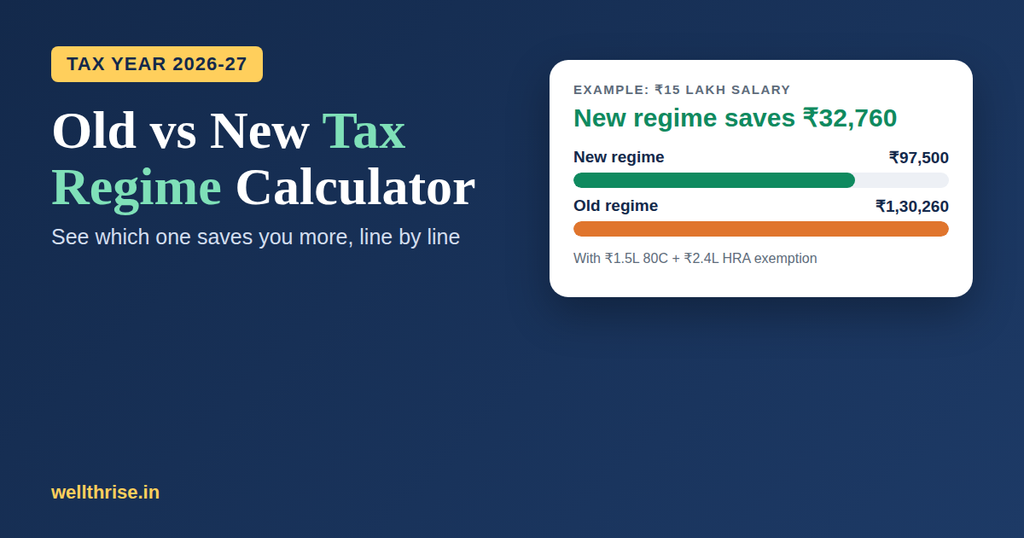
The new regime costs ₹97,500. The old regime only wins if your deductions beyond the standard deduction exceed about ₹5.44 lakh. Most people at this salary don’t reach that unless they have both a home loan and high rent.
Can I claim HRA in the new regime?
No. HRA, 80C, 80D, home loan interest on a self-occupied house and most other deductions are only available in the old regime. The new regime allows the ₹75,000 standard deduction and your employer’s NPS contribution (up to 14% of basic). If you claim HRA in the old regime, make your monthly receipts with our free rent receipt generator.
Does my own EPF count for 80C?
Yes. Your share of EPF (usually 12% of basic) counts towards the ₹1.5 lakh 80C limit, so many salaried people are already close to the limit without any extra investment. Check your salary slip. To see exactly how much PF is cut and where it goes, read our PF rules guide.
Is this calculator accurate for my situation?
It follows the 2026-27 slabs, rebate, surcharge and cess rules for a resident salaried person, including marginal relief. It doesn’t handle capital gains, business income, agricultural income or arrears relief. For those, use the Income Tax Department’s calculator or ask a CA.
Read next on WellthRise
Sources: TaxHeal: tax slabs for 2026-27 · BasuNivesh: new vs old regime after Budget 2026 · Tax2Win: surcharge and marginal relief · Patron Accounting: 50% HRA for 8 cities · CalcGuru: 80C is now section 123 · Income Tax Department. Educational content, not tax advice. Your actual tax depends on your full income details. Check with a chartered accountant before filing.
We write practical guides on money, tax, salary, wellness and India news. Rates, rules and dates come from official sources such as RBI, SEBI, the Income Tax Department, India Code and government notifications, linked in each article with the date we last checked them. We don’t accept payment to change what we write.
Our editorial policyReport an error