
PF rules explained: how much is deducted, how much you can withdraw, and when you get it all
Every month, up to 24% of your basic pay goes into PF, but most employees never learn where it goes. This guide answers the questions everyone has, using the new EPF Scheme 2026 and the ₹25,000 wage ceiling that started in September. It also has a calculator for your own numbers.
⚡ The 30-second answer
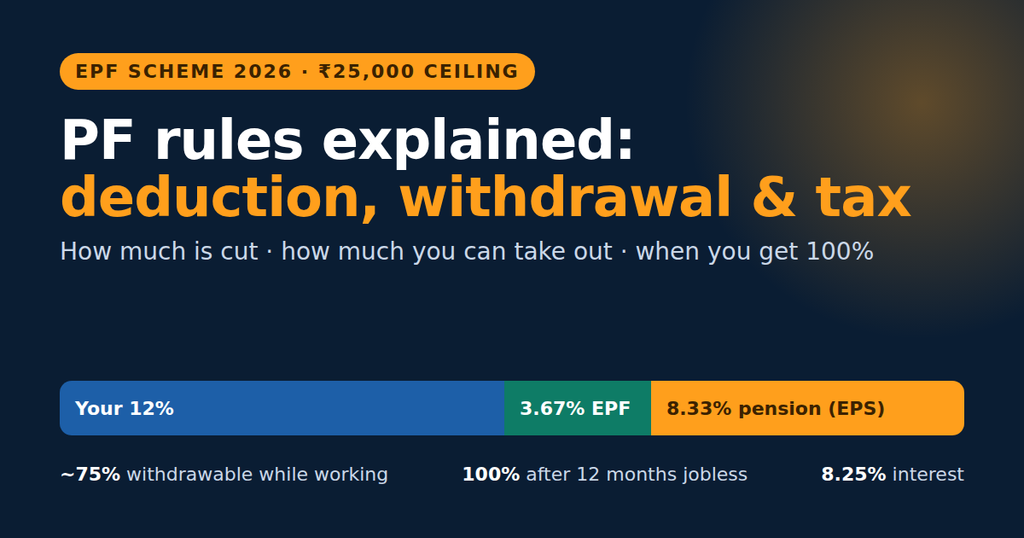
- Deduction: 12% of your PF wages (basic + DA) is cut from your salary. Your employer adds another 12%, but only 3.67% of it reaches your PF account. The other 8.33% goes to the pension scheme (EPS).
- While working: after 12 months of membership, you can withdraw up to your balance minus 25%. In practice, that’s about 75%.
- Full 100%: only at retirement (55+), after 12 months in a row without a job, or if you move abroad permanently.
- Pension part: it can’t be withdrawn like PF. With 10+ years of service it becomes a monthly pension. With less, you get a lump sum, but only 36 months after leaving.
- Tax: withdrawals after 5 years of continuous service are tax-free. Before that, TDS applies to amounts above ₹50,000.
01 · The deductionHow your company deducts PF, explained with a payslip
PF is calculated on your PF wages, which are your basic pay plus dearness allowance (DA). It isn’t calculated on your full salary or CTC. Since the new labour codes took effect, “wages” also has to be at least 50% of your total pay, so companies can no longer keep basic artificially low to shrink PF.
Each month, two things happen:
- Your share, 12%: deducted from your salary. It’s the “PF” line on your payslip, and all of it goes into your EPF account.
- Employer’s share, 12%: paid on top, and usually counted inside your CTC. It’s split in two. 8.33% goes to the Employees’ Pension Scheme (EPS), calculated on a maximum of ₹25,000, so at most ₹2,083 a month. The rest goes to your EPF account.
Employers also pay small extra charges, about 0.5% each for EDLI insurance and EPFO administration. These don’t reach your account, but EDLI gives your family free life cover of ₹2.5 lakh to ₹7 lakh if you die while in service.
Two kinds of employers: this is why colleagues’ PF differs
🔒 “Capped” employers
They calculate PF only on wages up to the ceiling. This used to be ₹15,000, so the deduction was ₹1,800. Since September 2026 it’s ₹25,000, so the deduction is up to ₹3,000. If your basic is above ₹15,000, your PF deduction may have gone up and your take-home pay down by up to ₹1,200 a month.
📈 “Full basic” employers
Many large companies calculate PF on your full basic, even above the ceiling. Contributing above the ceiling is voluntary, but it’s written into many offer letters. For these employees, the new ceiling changes nothing on the payslip. Only the EPS part rises slightly.
Payslip examples (from October 2026)
| Monthly basic + DA | ₹20,000 | ₹40,000 (capped) | ₹40,000 (full basic) |
|---|---|---|---|
| Your deduction (12%) | ₹2,400 | ₹3,000 | ₹4,800 |
| Employer’s 12% | ₹2,400 | ₹3,000 | ₹4,800 |
| … of which goes to pension (EPS) | ₹1,666 | ₹2,083 | ₹2,083 |
| … of which goes to your EPF | ₹734 | ₹917 | ₹2,717 |
| Total added to your EPF each month | ₹3,134 | ₹3,917 | ₹7,517 |
Exception: if you first joined EPF after 1 September 2014 with a basic above the ceiling at that time, you may not be an EPS member at all. Then your employer’s full 12% goes to your EPF account. Your passbook shows it: check whether the “pension contribution” column has entries.
Interest: EPFO declared 8.25% for FY 2025-26, and the government ratified it in June 2026. Interest is worked out every month on your running balance but credited once a year. You can also contribute more than 12% through the Voluntary PF (VPF), up to 100% of your wages. It earns the same rate, but your employer doesn’t have to match it.
02 · Your numbersPF rules calculator: your monthly split, what you can withdraw today, and your PF at 58
Estimates only. The projection assumes today’s rules, the ₹25,000 ceiling and the chosen interest rate stay the same, and that you never withdraw. Withdrawable amounts assume no earlier partial withdrawals. The pension figure uses the standard EPS formula and is rough. Your EPFO passbook is the final word.
03 · While you’re workingHow much PF can you withdraw while still employed?
Under the EPF Scheme 2026, there’s one simple rule for every reason: after 12 months of membership, you can withdraw up to your Eligible Member Balance. That’s your total balance minus a minimum balance of 25%, which must stay in the account to keep earning interest. The minimum balance is 25% of everything credited (your share, the employer’s share and interest).
| Reason | How much | How many times |
|---|---|---|
| Illness (yours or family) | Up to the eligible balance | No fixed limit |
| Education (yours or children’s) | Up to the eligible balance | 10 times in your career |
| Marriage (yours, children’s, siblings’) | Up to the eligible balance | 5 times in your career |
| Housing (buying, building, home loan repayment, renovation) | Up to the eligible balance | 5 times in total |
| Special circumstances: no reason needed | Up to the eligible balance | 2 times every financial year |
The “special circumstances” route is the big change. You don’t have to prove a reason any more, so it covers job loss, a natural calamity or any other urgent need. Withdrawals you made under the old 1952 rules don’t count against these new limits.
Leaving your job before completing 12 months? You can still withdraw up to the eligible balance at that point. Claims up to ₹5 lakh are auto-settled, usually within 3–5 working days, if your KYC is complete. Withdrawal through UPI is being tested and is expected around the end of 2026, but it isn’t live yet.
04 · The full 100%When can you withdraw your complete PF?
That last 25%, and the full balance, comes out only through final settlement. You can claim it when:
| Situation | Full PF? |
|---|---|
| Retirement at 55 or later | Yes |
| Unemployed for 12 months in a row (no job in any PF-covered company) | Yes, after 12 months |
| Permanently moving abroad to settle or work | Yes |
| Permanent and total disability that ends your working life | Yes |
| Retrenchment, or retirement under a voluntary retirement scheme | Yes |
| Resigned and joined a new job | No: transfer it instead |
| Resigned and still looking for a job | ~75% now, the rest after 12 months |
05 · The pension partWhat happens to the EPS money?
The 8.33% that goes to EPS works differently from PF. It isn’t your savings; it buys you a pension.
✅ 10 years of service or more
You get a monthly pension for life from age 58. You can take it early from 50, at a reduced rate (4% less for each year before 58). Formula: pensionable salary × years of service ÷ 70. Example: 20 years with ₹25,000 pensionable salary = about ₹7,143 a month. The minimum pension is ₹1,000.
⏳ Less than 10 years
You can’t get a pension. Instead, you get a lump-sum “withdrawal benefit” = pensionable salary × a factor based on your months of service. For 3 years at ₹15,000, that’s about ₹44,700. Under the 2026 rules, you can claim it only 36 months after your last contribution, or at 58 if that comes first.
Pensionable salary is the average of your PF wages over the last 60 months, capped at the ceiling. Most of the last five years fall under the old ₹15,000 ceiling, so the new ₹25,000 cap raises pensions gradually, not overnight.
Changing jobs? Don’t claim the withdrawal benefit. Your EPS service carries over to the new job through your UAN, and those years count towards the 10 you need for a pension. If you leave the workforce for a while, you can ask for a scheme certificate, which keeps your service record for when you return.
06 · TaxIs PF withdrawal taxable?
| Situation | Tax |
|---|---|
| Withdrawal after 5 years of continuous service (service at earlier employers counts if you transferred your PF) | Tax-free |
| Withdrawal before 5 years, amount up to ₹50,000 | No TDS, but the taxable part still has to be shown in your ITR |
| Withdrawal before 5 years, amount above ₹50,000 | 10% TDS (more if your PAN isn’t linked). Submit Form 15G/15H if your total income is below the taxable limit |
| Left before 5 years because of ill health, or the business shut down | Tax-free |
| Your contributions above ₹2.5 lakh a year (12% + VPF) | Interest on the excess is taxable every year |
| Employer’s contribution to PF + NPS + superannuation above ₹7.5 lakh a year | The excess and its interest are taxable as salary |
If you withdraw before 5 years, the employer’s share and its interest are taxed as salary, and interest on your own share as other income. Your own contributions are taxed only if you claimed an 80C deduction on them. A partial withdrawal while still employed follows the same 5-year test. Confirm with a tax adviser for your case.
07 · Job changeChanged jobs? Transfer, don’t withdraw
You keep one UAN (Universal Account Number) for life. When you join a new company, give them your existing UAN, not a new one. Most transfers now happen automatically once both employers are linked to it. If yours doesn’t, file a transfer request online with Form 13 on the EPFO member portal.
- Why transfer: your service stays continuous for the 5-year tax rule and the 10-year pension rule, and your money keeps earning 8.25%.
- Two UANs? Merge them through the “One Member One EPF Account” option on the portal. Otherwise the old account’s service doesn’t count.
- Old account with no contributions? It keeps earning interest until the account becomes inoperative under EPFO rules. But interest earned after you’ve stopped working can be taxable, so don’t leave it idle for years.
08 · Common confusionsPF myths that cost employees money
PF is 12% of my total salary.
It’s 12% of PF wages (basic + DA), and many companies cap it at ₹25,000. On a ₹1 lakh CTC with ₹40,000 basic, that’s ₹3,000 or ₹4,800, not ₹12,000.
My employer puts 12% into my PF account.
Only the part above the pension share does. 8.33% (up to ₹2,083) goes to EPS, which is why the passbook’s employer column looks small.
I can take out all my PF two months after leaving a job.
That was the old rule. Now full settlement needs 12 months without a job. You can still take about 75% right away.
The pension money is lost if I leave before 10 years.
It isn’t lost. You either carry the service to your next job or claim a lump sum 36 months after leaving.
PF withdrawal is always tax-free.
Only after 5 years of continuous service. Withdrawing every time you switch jobs is how people end up paying tax on it.
A new job means a new PF account.
Your UAN stays the same for life. A second UAN only creates work later.
09 · Step by stepHow to withdraw PF online
- Check your KYC. Log in to the EPFO member portal (unifiedportal-mem.epfindia.gov.in) or the UMANG app. Your Aadhaar, PAN and bank account must be linked and approved, and your UAN must be activated.
- Check your balance. Use the passbook on the portal, give a missed call to 9966044425, or SMS “EPFOHO UAN ENG” to 7738299899 from your registered mobile number.
- Open “Online Services → Claim”. Verify the last four digits of your bank account.
- Pick the claim type. Choose partial withdrawal (advance) while working, or final settlement once you qualify. EPS withdrawal is a separate pension claim.
- Choose the purpose and amount, then submit with the Aadhaar OTP. Most claims up to ₹5 lakh need no documents.
- Track the status under “Track Claim Status”. EPFO has to settle claims within 20 days, and auto-settled claims usually arrive within a week.
EPFO never asks for your UAN password or OTP on a call or WhatsApp. Agents who offer to “speed up” a PF claim for a fee are a common scam. Read our WhatsApp and UPI scams guide.
FAQPF questions employees ask most
How much PF is deducted from salary in 2026?
12% of your PF wages (basic + DA). If your company caps PF at the ceiling, the maximum is now ₹3,000 a month (12% of ₹25,000), up from ₹1,800. If it calculates PF on your full basic, it’s 12% of the full amount.
How much PF can I withdraw while still working?
After 12 months of membership, you can withdraw up to your balance minus a 25% minimum balance, which is roughly 75%. You can do this for illness, education, marriage or housing, or twice a year under “special circumstances” without giving a reason.
When can I withdraw 100% of my PF?
At retirement (55+), after 12 months in a row without a job, on permanent migration abroad, or on permanent disability, retrenchment or VRS. The earlier rule of full withdrawal after 2 months without a job no longer applies.
Can I withdraw my EPS pension money?
Only if you have less than 10 years of service, as a lump-sum withdrawal benefit. Under the 2026 rules, you can claim it only 36 months after your last contribution. With 10+ years, you get a monthly pension from 58 instead.
Is PF withdrawal taxable?
No, if you have 5 years of continuous service, including transferred service from earlier jobs. Before that, the employer’s share and interest are taxable, and 10% TDS applies to withdrawals above ₹50,000.
What is the EPF interest rate for 2025-26?
8.25% a year, the same as the previous two years. The government ratified it in June 2026, and EPFO has started crediting it.
What changed with the ₹25,000 wage ceiling?
From 17 September 2026, PF is compulsory for employees earning up to ₹25,000 a month (earlier ₹15,000). For employers who calculate PF only up to the ceiling, both the employee and employer contributions can rise by up to ₹1,200 a month each, and the maximum EPS contribution rises to ₹2,083.
Keep readingRelated on WellthRise
Sources: AIR News: EPF Scheme 2026 notified · TaxGuru: EPF Scheme 2026 changes · KPMG: wage ceiling raised to ₹25,000 · SCC Online: Cabinet approval · Tribune: CBT withdrawal reforms · Business Standard: EPS 2026 changes · Upstox: EPS withdrawal benefit · ETV Bharat: 8.25% ratified · Outlook Money: UPI withdrawal status. Rules as of 13 October 2026. EPFO may issue further circulars, so check the EPFO portal before you claim. Educational content, not financial or tax advice.
We write practical guides on money, tax, salary, wellness and India news. Rates, rules and dates come from official sources such as RBI, SEBI, the Income Tax Department, India Code and government notifications, linked in each article with the date we last checked them. We don’t accept payment to change what we write.
Our editorial policyReport an error