
Stock Market India: Why Nifty Is Down 14% and What Could Happen Next
Oil above $100, a rupee near 97 to the dollar, record foreign selling and the first RBI rate hike in over three years have hit the stock market India investors watch most: the Nifty and the Sensex. Here’s what’s really driving the fall, what’s still working in India’s favour, three realistic scenarios for 2027, and what long-term investors should do now.
What happened: The Sensex rose 308 points and the Nifty gained about 0.5% to reclaim 23,000, a second straight day of gains and roughly 2% higher for the week. The rise was narrow: large-cap IT and pharma did the lifting, while the Nifty Midcap 100 fell 0.93% and the Smallcap 100 dropped 1.85%, with declining stocks outnumbering advancers by more than two to one. Nifty IT (+2.3%) led after Cognizant’s results, with Infosys, Wipro and Coforge up 3–4%, and pharma gained about 1.5–1.8%; consumer durables, media, PSU banks and energy were the weakest sectors, and Bank Nifty slipped 0.4%. Trent (+5.4%) and InterGlobe Aviation (+4.3%) rallied after their September-quarter results, while Shriram Finance, Nestle India and Adani Ports fell; Brent crude climbing above $113 on fresh US–Iran tensions weighed on the broader market, and the India VIX edged up to around 15.3.
What to watch next session:
- Nifty levels analysts are watching: support at 22,800, with the outlook staying positive while the index holds above it; resistance at 23,250, where a breakout is needed for confirmation (Vatsal Bhuva, LKP Securities).
- Global and macro cues: Brent crude (above $113 on US–Iran tensions), the rupee and global tech stocks amid renewed worries over AI valuations; central banks including the Fed, ECB and BoJ have held rates.
- Q2 results and flows: more September-quarter earnings, and foreign investor flows (FIIs sold a net ₹944 crore on Thursday while DIIs bought ₹1,924 crore, provisional).
Last 5 sessions
| Date | Nifty 50 | Change |
|---|---|---|
| Fri, 30 Oct | 23,053.10 | +0.51% |
| Thu, 29 Oct | 22,936.75 | +1.05% |
| Wed, 28 Oct | 22,698.85 | −0.22% |
| Tue, 27 Oct | 22,749.75 | −0.02% |
| Mon, 26 Oct | 22,753.20 | +0.68% |
Updated after market close every trading day (Mon–Fri). Sources for 30 Oct: Business Standard, HDFC Sky; Bank Nifty and India VIX from NSE index data. Analyst levels are their views, not ours. This is market information, not investment advice.
Market levels at close on 30 October 2026. Sources at the end of this article.
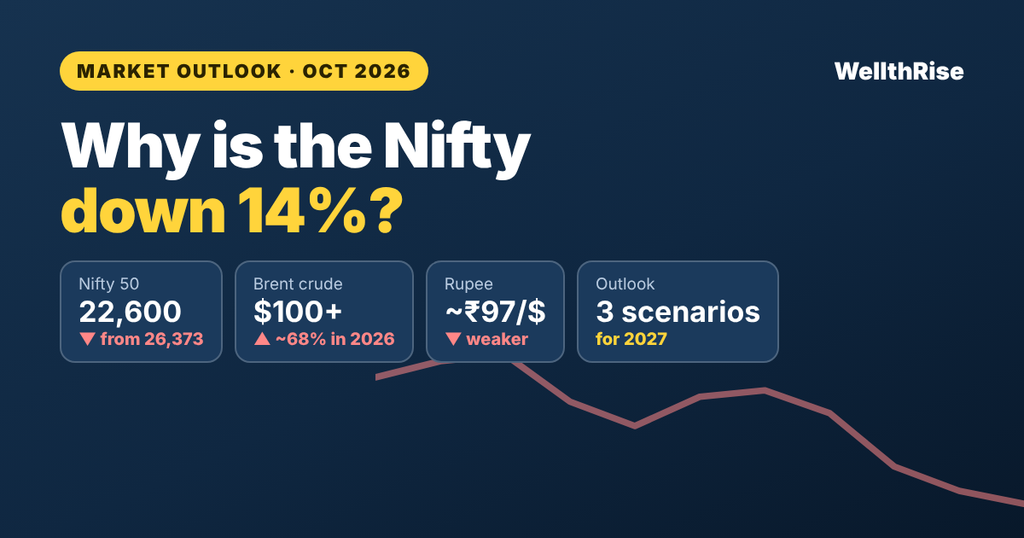
- The Nifty peaked at 26,373 on 5 January 2026 and closed at 22,600 on 23 October, about 14% lower. Midcaps and smallcaps fell 2–3% on 23 October alone.
- The main cause is an oil shock from the West Asia conflict, which is hurting the rupee, pushing up inflation and driving foreign investors out.
- India’s economy is still growing fast (7.8%), Indians are investing more than ever through SIPs (a record ₹32,490 crore in September), and the Nifty is now valued close to its long-term average.
- Most brokerages still see the Nifty higher by end-2027, but almost all of them depend on oil cooling down. Until that happens, expect a volatile, sideways-to-weak market.
Stock market India: why is it falling? 6 reasons
Brent crude crossed $100 in September and has stayed high, up about 68% in 2026 after the West Asia conflict and disruption around the Strait of Hormuz. India imports almost 90% of its crude, and the oil import bill jumped about 57% in April–July. Petrol in Delhi went from ₹94.77 to ₹102.12 in May.
The rupee slid from about 95 to the dollar at the end of August to beyond 97 in early October. Costlier oil weakens the rupee, and a weaker rupee makes oil even costlier. It also cuts the dollar returns of foreign investors.
Foreign portfolio investors sold a net ₹3.08 lakh crore of Indian shares in 2026 up to 12 October, almost double all of 2025. With the US 10-year Treasury yield above 5%, global money can earn a safe return at home, and the AI boom is pulling capital towards the US, Taiwan and Korea, where India has little exposure.
Retail inflation rose to 5.54% in September (food inflation 7.74%). On 7 October the RBI raised the repo rate by 0.25% to 5.50%, its first hike since February 2023, and took rate cuts off the table. Higher rates make loans dearer and shares less attractive than fixed deposits.
Company profits are growing, but not faster than expected. Consensus FY27 earnings estimates rose only about 0.2% in three months, according to Bernstein. Early September-quarter results show margin pressure from higher input costs in several companies.
Big IPOs, including the Jio Platforms issue, and block deals are soaking up money that might otherwise have gone into listed stocks. Smallcaps still trade at a premium to their history, which is why they are falling harder than the Nifty.
What’s still working for the stock market in India
GDP grew 7.8% in April–June 2026, beating estimates, and the RBI raised its FY27 growth forecast to 7.1% even while hiking rates. This is a market problem driven mainly by oil, not a broken economy.
Domestic institutions bought about ₹6.8 lakh crore of shares in 2026, more than double what foreigners sold. Monthly SIP inflows hit a record ₹32,490 crore in September, and equity fund inflows rose 31% that month, even as the market fell.
After the fall, the Nifty trades at roughly 17–18 times next year’s expected earnings, close to or slightly below its 10-year average. India is no longer the most expensive big emerging market by the wide margin it once was.
The Finance Minister has said the government is open to suggestions on removing long-term capital gains (LTCG) tax ahead of the next Budget. Nothing is decided, but any relief could lift sentiment.
Stock market India prediction: three scenarios for 2027
Nobody can predict the exact level of the stock market, in India or anywhere else, and anyone who claims to is guessing. What we can do is map out what would have to happen for the Nifty to go lower, move sideways or recover. The biggest swing factor in every scenario is the price of oil.
- Brent stays above $110–120
- Rupee crosses 100 to the dollar
- RBI hikes again; FPI selling continues
- Weak monsoon hurts rural demand
- Oil eases slowly to $85–100
- Earnings grow about 9–13%
- RBI holds rates; DIIs keep buying
- A “time correction”: flat prices while earnings catch up
- Ceasefire, Brent below $80
- Rupee steadies; FPIs return
- LTCG relief in the Budget
- Earnings upgrades from Q3 onwards
These ranges are WellthRise’s illustrative scenarios for the next 12 months, built from the brokerage views and data in this article. They are not forecasts or advice.
What the big brokerages say
| Brokerage | Target | For | When set |
|---|---|---|---|
| Bernstein | Nifty 25,000 (cut from 26,000) | Dec 2026 | 19 Oct 2026 |
| Goldman Sachs | Nifty 29,000, India back to Overweight | End-2026 | Mid-2026 |
| Morgan Stanley | Sensex 95,000 base, 76,000 bear (Brent near $100), 1,07,000 bull | Dec 2026 | Apr 2026 |
| Jefferies | Nifty 28,300 | Dec 2026 | Dec 2025 |
Notice the pattern: the most recent call (Bernstein, after oil crossed $100) is also the most cautious. Morgan Stanley’s own bear case assumed Brent near $100, which is roughly where it is today. Expect more targets to be cut as brokerages update their numbers. Even so, most still see the Nifty above today’s level within a year or so.
History: how long do Nifty corrections last?
A 14% fall feels painful, but it isn’t unusual. Here are the big Nifty corrections of the last two decades (approximate closing levels):
| Correction | Fall from peak | Main trigger | Back to old high |
|---|---|---|---|
| 2008 | About 60% | Global financial crisis | About 3 years (late 2010) |
| 2010–11 | About 28% | Inflation, rate hikes, rupee | About 3 years |
| 2015–16 | About 25% | China slowdown, FPI selling | About 2 years |
| 2020 | About 38% | Covid lockdown | About 10 months |
| 2021–22 | About 18% | Oil spike (Ukraine war), rate hikes, FPI selling | About 13 months |
| 2026 | About 14% so far | Oil shock, rupee, FPI selling, rate hike | ? |
For the stock market, India’s closest match is 2022: an oil spike from a war, rising rates and heavy foreign selling, while domestic investors kept buying. Then, the Nifty fell about 18% and took around a year to reach a new high. History doesn’t repeat exactly, but it shows that corrections caused by an external shock tend to heal once the shock fades.
Stock market India: what should investors do now?
Falling markets are when SIPs buy more units for the same money. Stopping now locks in the worst part and skips the recovery.
If falling prices keep you awake, you may own more equity than suits you. Rebalance to a mix you can hold through a bad year.
An emergency fund in a savings account or FD means you never have to sell shares at a low price to pay bills.
Have a lump sum to invest? Spreading it over 6–12 months lowers the risk of buying just before another leg down.
Smallcaps are still pricier than their history and fall the hardest. Prefer diversified large-cap, flexi-cap or index funds for new money.
With volatility (VIX) rising, borrowed money and options can turn a temporary fall into a permanent loss.
Rate hikes have a silver lining for savers: fixed deposit and small-savings rates are attractive again. Compare options in our PPF vs FD vs SCSS guide, see what the hike means for your loan in our RBI repo rate hike explainer, and model a long-term plan with our SIP calculator. Gold has done well this year too; track it on our gold rate page.
Stock market India: what to watch in the coming weeks
- Brent crude: analysts flag $110 as a level that could hurt sentiment further. A sustained fall below $90 would be the clearest positive signal.
- The rupee: whether it holds below 100 to the dollar.
- September-quarter results: through late October and November. Watch margins and management comments on demand.
- FPI flows: a few weeks of net buying would be an early sign the worst is over.
- RBI’s December policy and the Union Budget (February 2027): especially any decision on LTCG tax.
Stock market India FAQs
Stock market India: why is it falling in October 2026?
Mainly because of high crude oil prices (Brent above $100), a weak rupee near 97 to the dollar, heavy selling by foreign investors, and the RBI’s first rate hike since 2023. Higher US bond yields and lack of earnings upgrades add to the pressure.
Will the Nifty fall further?
It could if oil climbs above $110–120 or the rupee weakens past 100. Analysts see support around 22,200–22,500 in the near term. Nobody can predict the bottom reliably, which is why staggered, long-term investing works better than trying to time it.
Is this a good time to invest in the stock market?
For long-term investors, valuations are now closer to their historical average than at any time in the last few years. Investing gradually through SIPs or staggered lump sums lowers the risk of bad timing. Only invest money you won’t need for at least 5 years.
Should I stop my SIP when the market falls?
Usually not. A falling market lets your SIP buy more units at lower prices, which helps returns when the market recovers. Stop or reduce only if you genuinely can’t afford the amount.
When will the stock market recover?
No one knows exactly. In 2022, a similar oil-and-rates correction took about a year to reach a new high. A lasting fall in crude prices and the return of foreign investors would be the key signs of recovery.
What is the Nifty target for December 2026?
Brokerage targets range from 25,000 (Bernstein, set on 19 October 2026) to 29,000 (Goldman Sachs, set mid-2026). Older targets were set before oil crossed $100 and may be cut.
Related on WellthRise Stock Market India
- RBI repo rate hike: what it means for your EMI and FD
- Petrol price 2014 vs 2026
- Inflation calculator India: what things cost the year you were born
Sources and how we checked
Last checked: 23 October 2026, after market close. Market levels and flows change daily; foreign flow figures are NSDL data unless stated, and daily exchange figures are provisional.
- Market close, 23 Oct: Business Standard
- Nifty peak, FPI/DII flows, US yields: Daily Financial; fortnightly flow review (1–15 Oct); Moneycontrol via TradingView
- Crude, rupee and import bill: StockEdge analysis; valuations: Shoonya
- RBI policy, 7 Oct 2026: RBI policy summary; CPI September 2026: MoSPI press release
- GDP Q1 FY27: 5paisa; SIP data: AMFI September 2026 data
- Brokerage targets: Bernstein (Business Standard); roundup of Morgan Stanley, Goldman Sachs and Jefferies views
We write practical guides on money, tax, salary, wellness and India news. Rates, rules and dates come from official sources such as RBI, SEBI, the Income Tax Department, India Code and government notifications, linked in each article with the date we last checked them. We don’t accept payment to change what we write.
Our editorial policyReport an error