Book That Consultation
Hair transplant is no longer a celebrity secret or a luxury procedure. In 2026, it’s mainstream, increasingly affordable, and available in every major Indian city. But with that mainstreaming has come a flood of clinics, misleading marketing, and patients who didn’t know what they were signing up for. This guide cuts through all of it.
India now performs more hair transplants per year than almost any other country — and for good reason. International patients save 60–75% compared to USA or UK pricing. But the same market that offers world-class surgeons also has low-quality operators cutting corners. Knowing the difference could be the most important research you do.
Whether you’re a man dealing with a receding hairline, a woman experiencing diffuse thinning, or just curious about how this whole thing works — here’s the complete, honest breakdown.
💡 What Is a Hair Transplant — And How Does It Work?
A hair transplant is a surgical procedure that moves hair follicles from a “donor area” (usually the back and sides of your scalp, where hair is genetically resistant to falling) to a “recipient area” (where you’re experiencing hair loss). The transplanted follicles are permanent — they keep the same genetic properties from where they came from, which means they keep growing for life.
The science behind it is elegantly simple: DHT-resistant follicles from the back of your head will remain DHT-resistant even when moved to the front. That’s why results are permanent, unlike topical treatments like minoxidil which only work as long as you use them.
Hair loss in both men and women is driven by DHT (dihydrotestosterone), a hormone that miniaturises genetically susceptible follicles over time. The follicles at the back and sides of the scalp are not susceptible to DHT — they’re programmed differently. When you transplant them to a balding area, they bring their DHT-resistance with them. This is called “donor dominance” and it’s the biological reason hair transplants produce permanent results.
What this also means: your donor supply is finite and irreplaceable. Overharvesting creates permanent thinning and a “moth-eaten” appearance that cannot be reversed. This is why conservative planning by an experienced surgeon matters more than chasing maximum graft counts.
🔬 The 5 Techniques Available in 2026 — What’s Right for You?
The field has evolved dramatically. Here’s every technique currently available — from the gold standard to the experimental.
Individual follicles extracted one-by-one using micro-punch tool. No linear scar. Most widely used globally.
Grafts implanted directly using Choi implanter pen. No incisions made first. Better density and angle control.
Uses a specialized implanter pen for precise angulation and direction control, producing results that closely replicate natural hair growth. Faster healing than standard FUE.
A strip of scalp is removed from the back and follicles are extracted from it. Leaves a linear scar. Higher graft count possible in one session.
Modern systems improve precision, hygiene, safety, and success rates. However, a surgeon’s experience still matters more than machines.
The best technique depends on hair loss stage, donor area quality, hair type, and desired density. FUE is the most versatile. DHI gives the most natural density for smaller areas. Sapphire FUE is excellent for sensitive scalps. FUT is only recommended when maximum grafts in one session are needed. Always get a surgeon’s assessment first — not a clinic’s sales pitch.
👨👩 Hair Transplant for Men vs Women — It’s Not the Same Procedure
The biggest misconception about hair transplants is that they work the same way for men and women. They don’t — the hair loss pattern, graft requirement, technique, and success factors are meaningfully different.
- Pattern: Receding hairline + crown thinning
- Graded on Norwood Scale (1–7)
- Typically needs 1,500–4,000+ grafts
- Clearer donor zone — back and sides stable
- Higher total graft count needed
- FUE and FUT both commonly used
- Success predictability: High
- Cost range: ₹50,000–₹4,00,000
- Pattern: Diffuse thinning across crown
- Graded on Ludwig Scale (I–III)
- Women rarely need 3,000+ grafts. Most fall in ₹60,000–₹1,20,000 range
- Donor zone less defined — more complex
- DHI preferred — less trauma, better density
- Female hair transplants often more expensive per graft due to procedural complexity
- Hormonal evaluation mandatory before surgery
- More prone to shock loss post-surgery
Female hair loss can be caused by hormonal imbalances (PCOS, thyroid), nutritional deficiencies (iron, vitamin D), or medical conditions — none of which a hair transplant will fix. Surgery on actively thinning hair caused by an underlying condition can worsen outcomes significantly.
Before any consultation for a hair transplant, women should get: complete blood count, thyroid panel (TSH, T3, T4), ferritin levels, hormone panel (LH, FSH, prolactin), and vitamin D levels. A dermatologist’s clearance is non-negotiable — not optional.
✅ Real Benefits of a Hair Transplant in 2026
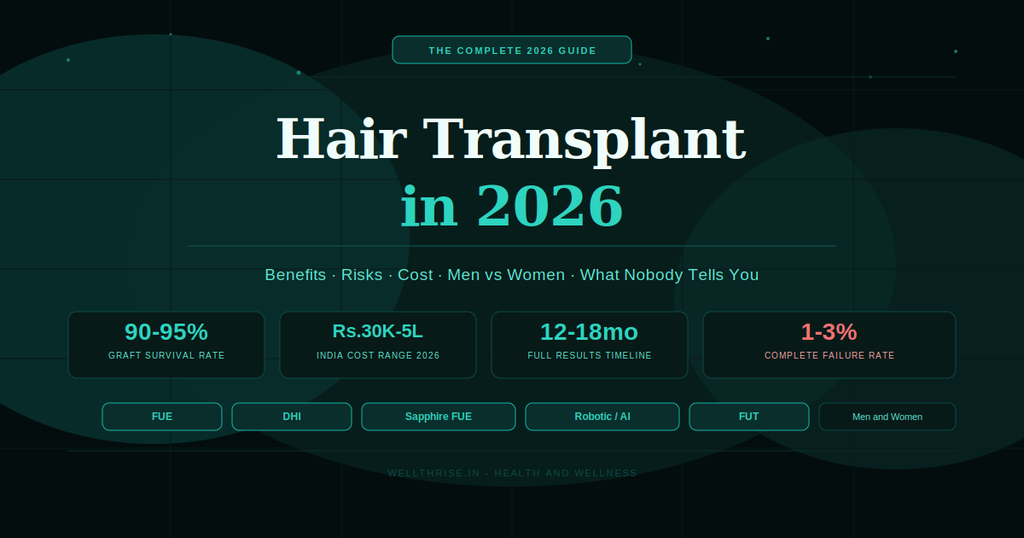
This is the headline benefit — and in 2026 it’s genuinely deliverable at quality clinics. Modern FUE and DHI techniques reach graft survival rates above 90–95%, meaning most patients enjoy dense, natural growth after 12–18 months. The results are yours permanently. Unlike Minoxidil or Finasteride, you don’t need to keep applying or taking something every day.
Multiple peer-reviewed studies have documented significant improvements in self-esteem, social confidence, and quality of life after successful hair transplants — particularly in men under 45. Hair loss in Indian culture carries real social stigma, and for many patients, the psychological benefit alone justifies the procedure. This isn’t vanity. It’s documented wellbeing improvement.
Hair transplant cost in different countries in 2026 ranges from $1,200–$4,500 in low-cost destinations like Turkey, India, and Mexico, to $8,000–$20,000+ in high-cost countries such as the USA, UK, and Australia. A procedure that costs ₹1.5–₹3 lakh in Delhi or Mumbai would cost ₹10–₹15 lakh equivalent in the UK or US. International medical tourists are increasingly choosing India for exactly this reason.
Modern FUE and DHI procedures are outpatient — you go home the same day. Most patients return to desk work within 3–5 days. There’s no general anaesthesia, no hospital stay, and no stitches with FUE. The “ugly duckling phase” (where transplanted hair sheds before regrowing) lasts 2–8 weeks but is completely normal and temporary.
The future beyond 2026: experts believe it may include hair cloning, 3D-printed follicles, advanced stem cell regeneration, and AI-guided transplantation systems. But even today, AI-assisted hairline design and robotic extraction are improving consistency and reducing human error at premium clinics in Delhi, Mumbai, Bangalore, and Hyderabad.
⚠️ Real Risks — What Nobody’s Marketing Will Tell You
Much of the information available to consumers minimises or avoids risk discussion entirely. Language suggesting that procedures are routine, with minimal downtime or without meaningful risk, creates an incomplete and often misleading picture. Here’s the honest version.
A 2023 peer-reviewed study of 621 FUE patients found female sex was a major risk factor for recipient-site shock loss, with an odds ratio of 30.18. Women are far more likely to experience it than men, making this critical information for female patients.
Shock loss means the transplanted — and sometimes surrounding native — hair falls out 2–8 weeks after surgery. For women this is psychologically devastating if they weren’t prepared for it. It IS temporary (regrowth begins 3–4 months later), but women must be explicitly counselled about this before surgery, not after.
Patients are advised to confirm that all surgical stages of their procedure will be performed or directly supervised by a qualified, licensed hair transplant surgeon. Clinics that delegate extraction and implantation to unlicensed technicians introduce significant variability in outcomes and increase the risk of complications requiring corrective surgery.
Overall complication rates range from 1.2% to 4.7% according to a 2024 scoping review — with most adverse events described as mild and self-limited. But those numbers are from qualified settings. At low-quality clinics, the rates are meaningfully higher.
- Gives a price quote before examining your scalp and donor area
- Promises results in “3–4 months” (full results take 12–18 months)
- Cannot tell you which doctor will perform the extraction
- Uses phrases like “painless”, “zero risk”, or “guaranteed results”
- Has no before/after photos from their own patients (stock photos are a red flag)
- Pressures you to book the same day as consultation
- Cannot explain what happens if results are unsatisfactory
- Doesn’t ask about your medical history, medications, or hormone levels
💰 Hair Transplant Cost in India — Complete 2026 Breakdown
The hair transplant cost in India in 2026 cannot be reduced to one fixed number. The most useful approach is to compare treatment plans rather than advertisements. Here’s the full picture.
Per-Graft Pricing by Technique
| Technique | Per Graft (India) | 2,000 Grafts | 3,000 Grafts | Tier |
|---|---|---|---|---|
| FUT (Strip) | ₹20–₹50 | ₹40K–₹1L | ₹60K–₹1.5L | Budget |
| Standard FUE | ₹30–₹80 | ₹60K–₹1.6L | ₹90K–₹2.4L | Standard |
| Sapphire FUE | ₹50–₹100 | ₹1L–₹2L | ₹1.5L–₹3L | Mid-range |
| DHI | ₹60–₹120 | ₹1.2L–₹2.4L | ₹1.8L–₹3.6L | Premium |
| AI/Robotic FUE | ₹80–₹150 | ₹1.6L–₹3L | ₹2.4L–₹4.5L | Super Premium |
City-Wise Price Range (FUE, 2,000–2,500 grafts)
| City | Budget Clinic | Mid-Range | Premium Clinic |
|---|---|---|---|
| Delhi / NCR | ₹40,000–₹80,000 | ₹1L–₹2L | ₹2.5L–₹4L |
| Mumbai | ₹60,000–₹1L | ₹1.5L–₹2.5L | ₹3L–₹5L |
| Bangalore | ₹50,000–₹90,000 | ₹1.2L–₹2.2L | ₹2.5L–₹4.5L |
| Hyderabad | ₹40,000–₹75,000 | ₹1L–₹1.8L | ₹2L–₹3.5L |
| Pune / Chennai | ₹35,000–₹70,000 | ₹90K–₹1.6L | ₹1.8L–₹3L |
| International (USA/UK) | ₹6L–₹10L | ₹10L–₹15L | ₹15L–₹25L+ |
Hidden Costs Nobody Mentions
| Item | Typical Cost | Mandatory? |
|---|---|---|
| Pre-op blood tests | ₹2,000–₹5,000 | Yes |
| Medicines (antibiotics, shampoo) | ₹2,000–₹5,000 | Yes |
| Follow-up appointments (3–4 visits) | ₹1,000–₹3,000/visit | Yes |
| PRP sessions post-transplant (recommended) | ₹3,000–₹8,000/session | Strongly recommended |
| Minoxidil (ongoing, to protect native hair) | ₹500–₹1,500/month | Often needed |
| Travel + accommodation (if going to another city) | ₹5,000–₹20,000 | If applicable |
🗓️ Recovery Timeline — Week by Week
Procedure takes 4–8 hours. Mild pain, scalp numbness, and redness are normal. You go home the same day. Sleep elevated (45°) to reduce swelling. No touching the grafts.
Small scabs form around each graft — this is normal healing. Swelling may spread to forehead. Social exclusion for approximately 15 days after the transplant is generally necessary. Most people take 5–7 days off work.
Shock loss is the temporary shedding of transplanted hairs, occurring 2–8 weeks post-surgery. This is a normal physiological response to surgical trauma. It is not a sign of failure. Many patients panic here — don’t. This is expected.
Fine baby hairs begin to appear in the transplanted area. Growth is slow and sparse at this stage. This is when many patients get impatient — the process cannot be rushed.
Hair thickens and coverage becomes noticeable. Most patients see 60–70% of their final results by month 9. Hair texture may still feel slightly different from native hair at this stage.
Full, mature results visible. Hair has integrated naturally, grows at normal rate, and can be cut, coloured, and styled exactly like your natural hair. This is your permanent result.
🎯 Are You a Good Candidate?
- Men with stable hair loss (not actively spreading)
- Norwood Scale 3–5 (significant but not total loss)
- Adequate donor density at back of scalp
- Age 25+ (loss pattern stabilised)
- Women with localised thinning, not diffuse
- Realistic expectations about timeline and density
- Healthy scalp, no active skin conditions
- Under 25 — loss pattern not yet stable
- Norwood 6–7 with very limited donor hair
- Women with active hormonal imbalance causing loss
- Alopecia areata (autoimmune — different condition)
- Active scalp infections or psoriasis
- On blood thinners (warfarin, aspirin)
- Expecting “celebrity density” from limited grafts
❓ Frequently Asked Questions
The Bottom Line — Is It Worth It?
For the right candidate, at the right clinic, a hair transplant in 2026 is genuinely life-changing. The technology is mature, the techniques are refined, graft survival rates are above 90% at quality facilities, and India offers world-class results at a fraction of Western prices.
The risks are real but manageable — as long as you go in with honest expectations, choose a surgeon-led clinic, and understand that results take 12–18 months. The biggest danger isn’t the procedure itself. It’s the marketing-driven, low-quality operators who promise the moon and deliver a moth-eaten donor area.
Do the research. Get multiple consultations. Ask every question in this post. And don’t let anyone pressure you into a same-day booking. Your hair — and your scalp — deserve better than that.
💬 Considering a hair transplant — or already had one? Share your experience or questions in the comments. And if this post helped you, share it with someone who’s been quietly Googling “hair transplant India” at 2am. They need this information. 🙏
Medical Disclaimer: This article is for informational purposes only and does not constitute medical advice. Always consult a qualified, board-certified dermatologist or hair transplant surgeon before making any decisions about hair restoration procedures. Individual results vary based on hair type, donor density, health conditions, and surgeon skill.