
Delhi Nursery Admission 2027-28: Dates, New Age Limits for Nursery, LKG and UKG, and an Eligibility Checker
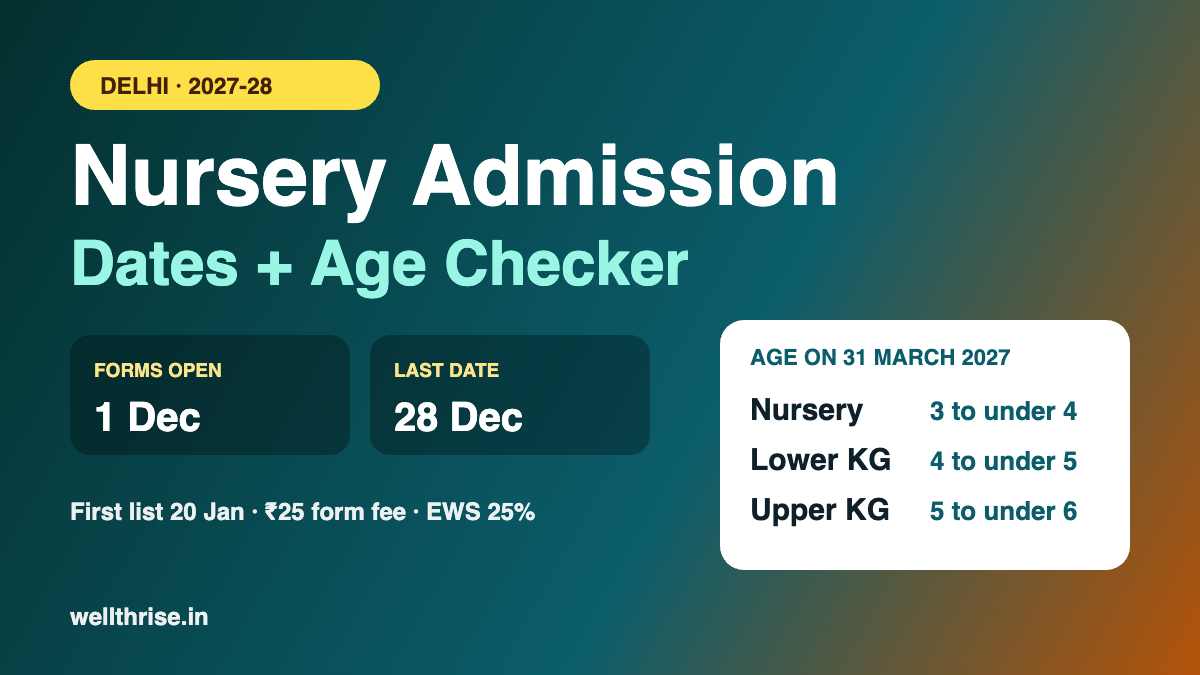
Delhi nursery admission 2027-28 forms open on Tuesday 1 December 2026 and close on 28 December. For the first time, Delhi schools are admitting children to Lower KG and Upper KG too, each with its own age band counted on 31 March 2027. Enter your child’s date of birth below to see which class they can apply for.
- Schedule: forms 1 to 28 December 2026; points list 4 January; first list 20 January 2027; second list 5 February; admissions close 12 March 2027.
- Age on 31 March 2027: Nursery 3 to under 4; Lower KG 4 to under 5; Upper KG 5 to under 6. A principal can relax the limits by up to one month.
- Class 1 in 2027-28: 5 to under 6, mainly for children moving up from KG. From 2028-29, Class 1 becomes 6 to under 7.
- Rules: form fee capped at ₹25, no interviews, no donations or capitation fee, and 25% of entry-level seats are reserved for EWS, DG and CWSN children.
Status last checked: 23 November 2026. Schedule from the Directorate of Education (DoE) circular as reported on 22–23 November 2026; age limits from the DoE order of 24 October 2025. Each school publishes its own points criteria.
Delhi nursery admission 2027-28 age checker
Which class can my child apply for?
Pick your child’s date of birth. The checker works out their age on 31 March 2027 and matches it to the DoE age bands, including the one-month relaxation.
Loading the checker…
Delhi nursery admission 2027-28 schedule
| Step | Date |
|---|---|
| Schools upload admission criteria and points to their website and the DoE portal | By 23–26 November 2026 (reports differ) |
| Application forms open | Tuesday 1 December 2026 |
| Last date to submit forms | Monday 28 December 2026 |
| Schools publish applicants with points | Monday 4 January 2027 |
| Parents’ queries or objections on points | 5 to 11 January 2027 |
| Final points list | Tuesday 12 January 2027 |
| First selection list and waiting list | Wednesday 20 January 2027 |
| Queries on the first list | 21 to 28 January 2027 |
| Second selection list (if seats are left) | Friday 5 February 2027 |
| Queries on the second list | 6 to 12 February 2027 |
| Further list for vacant seats | Monday 22 February 2027 |
| Admission process closes | Friday 12 March 2027 |
The EWS, DG and CWSN seats follow a separate computerised draw run by the Directorate of Education, with its own dates. Watch edudel.nic.in for that schedule.
Delhi nursery admission 2027-28 age limit for each class
Age is counted on 31 March 2027. “3 to under 4” means the child has turned 3 by 31 March 2027 but has not turned 4.
| Class (2027-28) | Age on 31 March 2027 | Date of birth between |
|---|---|---|
| Nursery (Balvatika 1) | 3 to under 4 | 1 April 2023 – 31 March 2024 |
| Lower KG (Balvatika 2) | 4 to under 5 | 1 April 2022 – 31 March 2023 |
| Upper KG (Balvatika 3) | 5 to under 6 | 1 April 2021 – 31 March 2022 |
| Class 1 | 5 to under 6 (for KG 2026-27 promotees) | 1 April 2021 – 31 March 2022 |
Why Class 1 and Upper KG share an age band this year: Delhi is moving to the national pattern of three pre-school years before Class 1. Upper KG starts in 2027-28 with new admissions only, while children already in KG this year move up to Class 1. From 2028-29, Class 1 will take children aged 6 to under 7.
The one-month relaxation
The head of the school can relax both the minimum and the maximum age by up to one month, for Nursery to Class 1. You have to ask in writing, and the principal decides. A child born in April 2024, for example, could be considered for Nursery with relaxation, but it is not guaranteed.
Children who passed the previous class from a recognised school, and have a valid school leaving certificate and mark sheet, are exempt from these age limits when moving to the next class.
How the points system works
For the 75% general seats, each private school sets its own points out of 100 and publishes them before forms open. Commonly used criteria include:
- Neighbourhood or distance from home to school, usually the biggest share of points.
- Sibling already studying in the school.
- Alumni parent who studied at the school.
- Staff ward, for children of the school’s employees.
Schools cannot give points for parents’ education, profession, gender, vegetarian food habits or not smoking or drinking, and they cannot interview the child or parents. When applicants tie on points and seats run short, the school must hold a draw of lots on video, with at least five days’ notice to parents.
Fees and what schools cannot do
- The registration fee is capped at ₹25, and it is not refundable.
- Buying the school prospectus is optional. A school cannot force you to buy one.
- Donations and capitation fees are banned. Schools caught taking them can be fined up to ten times the amount.
- No interviews or tests for the child or the parents.
Planning the cost of school fees over the years? Our SIP calculator and FD calculator show how much to set aside each month. If you have younger children, also see the pulse polio November 2026 dates.
Documents for Delhi nursery admission 2027-28
- Child’s birth certificate (the main proof of age).
- Proof of address: any one of Aadhaar, voter ID of either parent, passport, ration or smart card with the child’s name, electricity, water or telephone bill, or domicile certificate.
- Recent passport-size photos of the child and parents.
- Proof for any points you claim: sibling’s school ID, parent’s alumni certificate, or staff ID.
- For EWS or DG seats: income certificate or category certificate, as listed in the DoE’s separate notice.
Tips for parents
- Apply to several schools. Each school’s points are separate, and the first list on 20 January is not the last chance.
- Check the points list on 4 January. If your points are wrong, raise it with the school between 5 and 11 January, in writing.
- Keep the age band in mind. Applying for the wrong class is a common reason forms are rejected. Use the checker above.
- Mark the deadlines. Forms close on 28 December, during the winter holidays, so don’t leave it to the last week.
For the board exams your older child may be preparing for, see the CBSE board exam 2027 dates, and plan around the bank holidays in December 2026 if you need a demand draft or bank paperwork.
Delhi nursery admission 2027-28: FAQs
When will Delhi nursery admission 2027-28 forms start?
On Tuesday 1 December 2026. The last date to submit forms is Monday 28 December 2026, and the first selection list comes out on 20 January 2027.
What is the age limit for nursery admission in Delhi for 2027-28?
The child must be at least 3 and under 4 years old on 31 March 2027, which means born between 1 April 2023 and 31 March 2024. The principal can relax this by up to one month.
Are LKG and UKG admissions open in Delhi this year?
Yes. From 2027-28, Delhi schools have Lower KG (4 to under 5) and Upper KG (5 to under 6). Upper KG takes new admissions only this year.
What is the age for Class 1 admission in Delhi in 2027-28?
5 to under 6 on 31 March 2027, mainly for children moving up from KG. From 2028-29, Class 1 will be for children aged 6 to under 7.
How much is the nursery admission form fee in Delhi?
A maximum of ₹25, non-refundable. Buying the prospectus is optional.
When is the EWS nursery admission draw in Delhi?
EWS, DG and CWSN seats (25% of entry-level seats) are filled by a separate computerised draw by the Directorate of Education. Its schedule is announced separately on edudel.nic.in.
Sources
- Directorate of Education, Delhi: age criteria order for Nursery to Class 1 (24 October 2025)
- ETV Bharat: Delhi nursery admissions 2027-28 schedule out (22 November 2026)
- The Patriot: admissions from 1 December, rules on points and draws (23 November 2026)
- KollegeApply: dates, age limits and documents (23 November 2026)
- Directorate of Education, Delhi (official portal)
This page on Delhi nursery admission 2027-28 is for general information. Dates and rules come from the Directorate of Education; each school’s own criteria and the final DoE notices take priority. Last checked: 23 November 2026. Written by the WellthRise Editorial Team.
We write practical guides on money, tax, salary, wellness and India news. Rates, rules and dates come from official sources such as RBI, SEBI, the Income Tax Department, India Code and government notifications, linked in each article with the date we last checked them. We don’t accept payment to change what we write.
Our editorial policyReport an error