
FD Calculator India 2026: FD, RD and Flexi FD Returns After Tax, in One Place
Pick what you want to work out: an FD’s maturity after tax, a monthly RD, how much a flexi (sweep-in) FD adds to your savings account, the best of three offers, a goal, an FD ladder or the cost of breaking an FD early.
- Most bank FDs compound quarterly. At 6.5% that works out to an effective 6.66% a year.
- FD interest is fully taxable at your slab rate every year, even if you only get it at maturity. At the 30% slab, a 6.5% FD earns about 4.5% after tax.
- Banks deduct 10% TDS once your interest from one bank crosses ₹50,000 in a financial year (₹1 lakh for senior citizens). TDS isn’t extra tax; it’s adjusted when you file your return.
- After the RBI’s October 2026 repo rate hike, big banks pay around 6.25–6.50% for 1–5 years (senior citizens up to about 7.10%). Some small finance banks pay more.
FD calculator
1. Choose a calculator
2. Enter your numbers
FD maturity, tax and real return
Enter your deposit and this FD calculator updates as you type.
RD calculator (recurring deposit)
An RD is a monthly FD: you deposit the same amount every month and get it all back with interest at the end.
Flexi FD (sweep-in) calculator
With a flexi or sweep-in FD, money in your savings account above a limit you choose moves into an FD automatically. It earns FD interest but you can still withdraw it any time.
Compare up to 3 FDs
Pre-filled with sample rates from October 2026. Change them to the offers you’re considering.
Goal planner
How much to deposit today to reach a target, or how long your money takes to grow there.
FD ladder planner
Split your money into FDs that mature one year apart, so part of it is always about to free up and you can reinvest at newer rates.
Break FD early: what you’ll actually get
Banks pay the rate for the period you actually stayed, minus a penalty (usually 0.5–1%), not your booked rate.
💡 Figures are estimates. Banks round interest, count exact days and may pay slightly different amounts, especially for monthly payouts and odd tenures. Tax is estimated on interest earned each year at your slab plus 4% cess.
How the FD calculator works out your interest
For cumulative FDs, banks use compound interest, usually quarterly, and so does this FD calculator:
Maturity = P × (1 + r/n)n × t, where P is the deposit, r the yearly rate, n the number of times interest is compounded each year (4 for quarterly) and t the tenure in years.
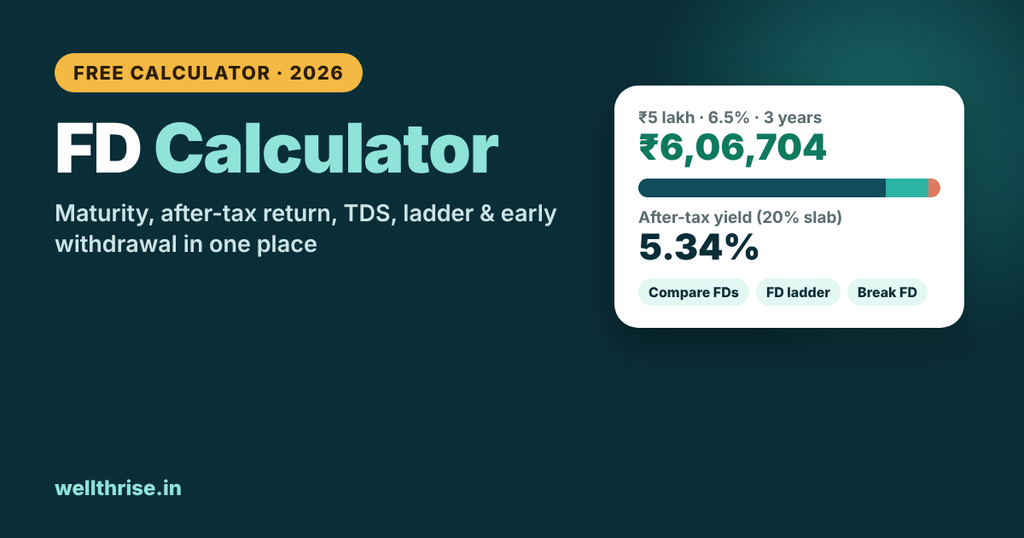
For example, ₹5 lakh at 6.5% for 3 years with quarterly compounding grows to about ₹6,06,700, and the interest is roughly ₹1,06,700. If the tenure doesn’t divide into whole quarters, banks add simple interest for the leftover days. Deposits shorter than six months usually earn simple interest.
If you choose a monthly or quarterly payout, interest isn’t compounded: it’s paid out to your account. Quarterly payouts are simply P × r ÷ 4. Monthly payouts are slightly lower than r ÷ 12, because banks discount them to match the quarterly rate.
RD calculator: how recurring deposit interest works
A recurring deposit (RD) lets you save a fixed amount every month, from as little as ₹100 at most banks and post offices. Each instalment earns interest, compounded quarterly, for as long as it stays deposited. So your first instalment earns interest for the full term and your last one for just a month.
For example, ₹5,000 a month for 3 years at 6.5% means you deposit ₹1,80,000 and get back about ₹1,99,120. RD rates are usually the same as the bank’s FD rate for that tenure, and the interest is taxed and subject to TDS exactly like FD interest.
RD or SIP? An RD gives a fixed, guaranteed return. A mutual fund SIP can earn more over five years or longer but can also fall in value. For short goals of 1–3 years, an RD is the safer choice; for long goals, compare with our SIP calculator.
Flexi FD (sweep-in FD): FD interest without locking your money
A flexi FD, also called a sweep-in FD, auto-sweep or MODS at some banks, links a fixed deposit to your savings or salary account. You set a limit, say ₹50,000. Anything above it is moved into an FD automatically and earns FD interest. When you need money, the bank breaks just enough of the FD to cover it. For example, keeping ₹3 lakh in a savings account at 2.5% earns about ₹7,500 a year, but with a ₹50,000 sweep limit and a 6.25% sweep FD it earns about ₹17,300.
👍 Good for
- Emergency funds and salary that sits idle for weeks
- Earning FD interest without locking money away
- Avoiding the effort of opening and breaking FDs yourself
👀 Watch out for
- Some banks set a minimum sweep amount or charge a penalty on broken sweep FDs
- Interest is taxable, and TDS applies like any FD
- Many sweep FDs pay the 1-year rate, which may be lower than longer FDs
Most banks let you switch on auto-sweep in net banking or at the branch. Ask what the sweep limit, sweep unit and FD tenure are, and how broken amounts earn interest.
Tax and TDS on FD interest
Income tax
- FD interest is added to your income and taxed at your slab rate.
- Tax is due every year as interest accrues, even on cumulative FDs where you get the money only at maturity.
- Senior citizens can claim up to ₹50,000 of deposit interest as a deduction under section 80TTB, but only in the old tax regime.
TDS
- 10% TDS when interest from one bank crosses ₹50,000 in a financial year (₹1 lakh for senior citizens). 20% if the bank doesn’t have your PAN.
- If your total income is below the taxable limit, submit Form 15G (or 15H if 60+) at the start of the year to avoid TDS.
- TDS is credited against your final tax. If your slab is 20% or 30%, you pay the rest when you file.
7 ways to earn more from your FDs
- Compare beyond your own bank. Rates for the same tenure can differ by 1% or more between banks, especially small finance banks. The FD calculator’s “Compare 3 FDs” tab ranks offers by after-tax return.
- Check special tenures. Many banks pay their best rate on odd tenures such as 444 or 555 days rather than round years.
- Book in a senior citizen’s name if a parent is 60+: they usually get 0.25–0.75% extra and a higher TDS limit, but the interest is taxed in their hands.
- Ladder your deposits so money frees up every year and you’re not locked in at one rate.
- Split large amounts into several FDs, so you can break one in an emergency without touching the rest.
- Stay within insurance limits. DICGC insures up to ₹5 lakh per depositor per bank, including interest.
- Look at the after-tax number. At higher slabs, compare FDs with options like PPF, which is tax-free. Our PPF vs FD vs SCSS guide compares them.
For the latest bank changes, see our guide to the new FD rules in 2026 and what the October 2026 repo rate hike means for deposit rates.
Frequently asked questions
How does an FD calculator work out maturity?
Most banks compound FD interest quarterly: maturity = P × (1 + r/4)4t. ₹1 lakh at 7% for 5 years with quarterly compounding becomes about ₹1,41,478. Deposits under six months usually earn simple interest.
Is FD interest taxable?
Yes. It’s added to your income every year and taxed at your slab rate, even if you receive it only at maturity. Banks deduct 10% TDS above ₹50,000 of interest a year (₹1 lakh for senior citizens), which is adjusted against your final tax.
Which is better: quarterly payout or cumulative FD?
A cumulative FD earns more because interest is compounded. Choose a payout option only if you need regular income, such as in retirement.
What happens if I break an FD early?
The bank pays interest at the rate that applied for the period you actually kept the money, minus a penalty of usually 0.5–1%. Use the “Break FD early” tab to see the exact effect.
Are FD rates going up after the RBI hike?
The RBI raised the repo rate to 5.50% on 7 October 2026. Banks don’t have to change deposit rates immediately, and many big banks hadn’t changed FD rates by mid-October. Check your bank’s latest card rate before booking.
Is RD better than FD?
Neither is better in itself. An FD needs a lump sum and earns interest on all of it from day one. An RD builds savings monthly, so each instalment earns interest for a shorter time. Use an FD for money you already have and an RD to save from your monthly income.
Is a flexi FD worth it?
Usually yes, if you regularly keep more money in your savings account than you need. A sweep-in FD can earn two to three times the savings rate on the extra money, and you can still withdraw it any time. Check your bank’s sweep limit and penalty rules first.
Is my FD safe?
Deposits in banks are insured by DICGC up to ₹5 lakh per depositor per bank, covering principal and interest. Spread larger amounts across banks if safety is your priority.
Sources: Upstox: FD rates after the October 2026 repo rate hike; GoPocket: FD rates and small finance banks, October 2026; ClearTax: TDS on FD interest; DICGC: deposit insurance.
Last checked: 31 October 2026. Rates change often, so confirm with your bank before booking. This calculator is for general information and isn’t financial advice.
We write practical guides on money, tax, salary, wellness and India news. Rates, rules and dates come from official sources such as RBI, SEBI, the Income Tax Department, India Code and government notifications, linked in each article with the date we last checked them. We don’t accept payment to change what we write.
Our editorial policyReport an error