
NPS 2026: the complete guide to the National Pension System, with the new 80% withdrawal rule and a pension calculator
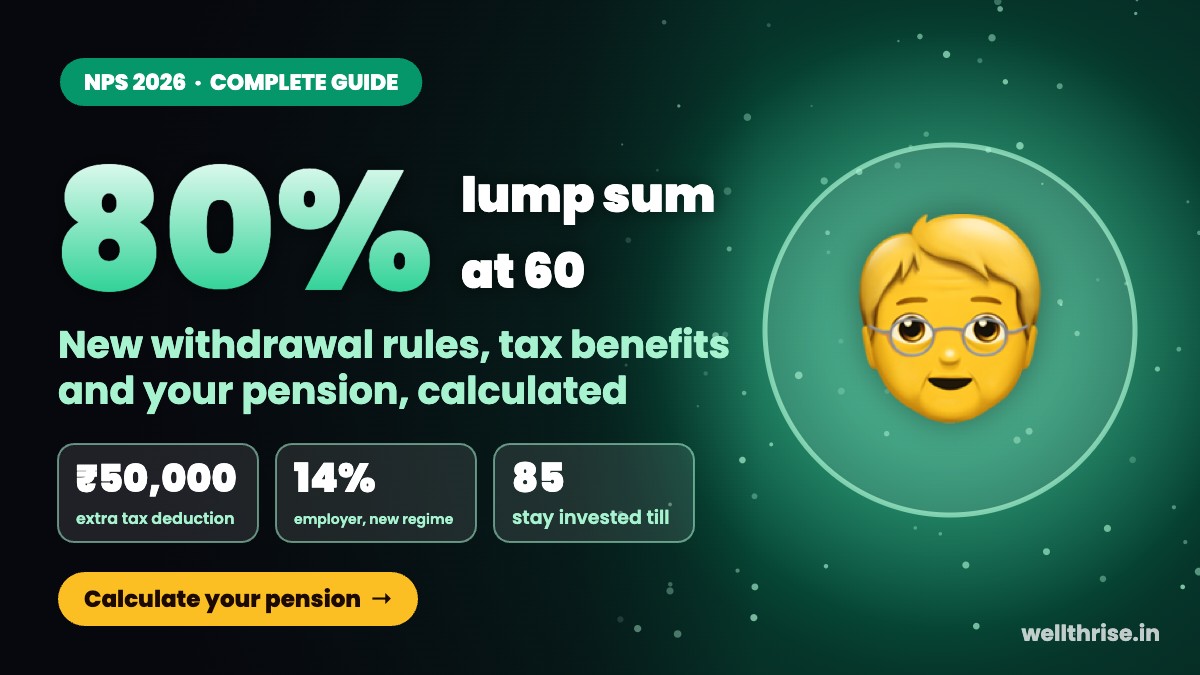
NPS is India’s low-cost, market-linked pension scheme. In December 2025 the rules changed in a big way: private-sector and self-employed subscribers can now take out up to 80% of their money at 60, and everyone can stay invested till 85. This guide covers everything people search for about NPS, from tax benefits and returns to withdrawal rules, charges and how to open an account, with a calculator for your own pension.
🧓- What it is: a retirement account regulated by PFRDA. Your money is invested in shares and bonds by a pension fund of your choice.
- Who can join: any Indian citizen, NRI or OCI aged 18 to 70.
- Tax benefit: up to ₹2 lakh a year under the old regime (₹1.5 lakh plus an extra ₹50,000). Under the new regime, only your employer’s contribution is deductible, up to 14% of basic pay plus DA.
- At 60 (non-government): take up to 80% as a lump sum. At least 20% buys an annuity, which pays a monthly pension. Government employees: 60% and 40%.
- Tax at exit: only 60% of the corpus is tax-free. Anything you take above that is taxed at your slab rate.
NPS calculator: your corpus and monthly pension
Change the numbers to see how much you could build by retirement, how much you can take out, and the pension it could pay.
NPS, short for National Pension System, was opened to all Indians in 2009 after starting as a pension scheme for central government staff in 2004. It is regulated by the Pension Fund Regulatory and Development Authority (PFRDA). This guide is written for the questions people search most about NPS. Every rule is from PFRDA, the tax law or a named report, linked at the end.
What is NPS and how does it work?
NPS is a defined-contribution pension. That means your pension is not fixed in advance. It depends on how much you put in and how the money grows. Here is how it works:
- You open an account and get a 12-digit Permanent Retirement Account Number (PRAN). It stays with you for life, even if you change jobs or cities.
- You (and your employer, if it offers NPS) put money in. There is no fixed monthly amount.
- A pension fund you choose invests the money in shares, corporate bonds and government bonds, in the mix you pick.
- At 60, you take part of the corpus as cash and use the rest to buy an annuity, which pays you a monthly pension for life.
NPS Tier 1 vs Tier 2
| Tier 1 (pension account) | Tier 2 (savings account) | |
|---|---|---|
| Required? | Yes, this is the main NPS account | Optional, needs an active Tier 1 |
| Minimum to open | ₹500 | ₹1,000 |
| Minimum after that | ₹1,000 a year | ₹250 a contribution |
| Withdrawals | Restricted till 60 (see rules below) | Any time, no lock-in |
| Tax deduction | Yes | No (except a 3-year lock-in variant for government employees) |
| NRIs and OCIs | Allowed | Not allowed |
For most people, Tier 1 is the account that matters. Tier 2 is simply a low-cost fund account and has no special tax benefit.
How to open an NPS account and log in
- Online (eNPS): open it in about 15 minutes on the NPS Trust website or your Central Recordkeeping Agency’s site, using your PAN, Aadhaar and a bank account. Accounts opened through eNPS pay no Point of Presence charges.
- Through a bank or broker: most large banks and some investment apps act as a Point of Presence (POP) and can open the account for you.
- Through your employer: if your company offers corporate NPS, it can deduct your contribution and its own from your salary.
NPS login: your account is kept by one of three Central Recordkeeping Agencies: Protean (formerly NSDL), KFintech or CAMS. Log in on your agency’s website or app with your PRAN and password to check your balance, change your fund, add a nominee or make a withdrawal request. Your PRAN card or welcome email shows which agency holds your account.
Documents: PAN, Aadhaar or another address proof, a photo and bank details. NRIs and OCIs also need a passport or OCI card and an NRE or NRO bank account.
NPS investment choices: active, auto and up to 100% equity
| Choice | How it works | Equity limit |
|---|---|---|
| Active choice | You decide the split between equity (E), corporate bonds (C), government bonds (G) and alternative assets (A) | Up to 75% |
| Auto choice LC75 (aggressive) | Equity falls automatically as you age | 75% till 35, down to 15% by 55 |
| Auto choice LC50 (moderate) | As above | 50% till 35, down to 10% by 55 |
| Auto choice LC25 (conservative) | As above | 25% till 35, down to 5% by 55 |
| Life Cycle Aggressive | Higher equity held for longer | 50% till 45, down to 35% by 55 |
| Multiple Scheme Framework (from 1 October 2025) | Non-government subscribers can hold several schemes under one PRAN, including high-risk variants | Up to 100% |
You can switch pension fund once a year and change your asset mix up to four times a year. If you are under 40 and comfortable with ups and downs, a high equity share has historically given the best long-term NPS returns. Closer to 60, shift towards bonds so a market fall does not hit you just before you retire.
NPS returns and the best pension fund managers
NPS has 11 pension fund managers, including SBI, LIC, UTI, HDFC, ICICI Prudential, Kotak, Aditya Birla Sun Life, Tata, Axis and DSP. Returns depend on the scheme and the fund. These were the top performers as of 27 July 2026:
| Scheme | 3 years | 5 years | 10 years |
|---|---|---|---|
| Equity (Scheme E) | 17.89% (Tata) | 16.53% (Kotak) | 14.83% (HDFC) |
| Corporate bonds (Scheme C) | 8.35% (HDFC) | 6.90% (HDFC) | 8.48% (HDFC) |
| Government bonds (Scheme G) | 7.89% (SBI) | 5.97% (Aditya Birla) | 8.82% (LIC) |
These are the best funds in each period, not the average, and returns are annualised. Past returns do not guarantee future returns. A blended NPS account with 50% to 75% in equity has historically returned roughly 9% to 12% a year over long periods, which is why the calculator starts at 10%.
NPS tax benefits 2026: old vs new regime
| Deduction | What it covers | Old regime | New regime |
|---|---|---|---|
| Section 80CCD(1) | Your own contribution, up to 10% of basic plus DA (20% of income if self-employed) | Yes, within the ₹1.5 lakh 80C limit | No |
| Section 80CCD(1B) | An extra deduction for your own contribution | Yes, up to ₹50,000 more | No |
| Section 80CCD(2) | Your employer’s contribution | Up to 10% of basic plus DA (14% for government) | Up to 14% of basic plus DA |
- The ₹7.5 lakh cap. Your employer’s total contribution to NPS, EPF and superannuation is tax-free only up to ₹7.5 lakh a year. Anything above that is taxed as a perk.
- New law, same limits. The new Income-tax Act, 2025, which applies from 1 April 2026, renumbers these sections. The limits are the same. We use the familiar old section names here because most people still search for them.
- What it saves. Using the extra ₹50,000 under the old regime saves about ₹15,600 a year in the 30% slab and ₹10,400 in the 20% slab, including cess.
Not sure which regime is better for you? Try our old vs new tax regime calculator. If your employer offers NPS in your salary package, it is one of the few tax breaks left in the new regime.
NPS withdrawal rules 2026
PFRDA amended the NPS exit and withdrawal rules in December 2025. These are the main ones now.
At 60 (normal exit)
| Your corpus | Private sector and self-employed | Government employees |
|---|---|---|
| Up to ₹8 lakh | Withdraw 100% as a lump sum | Withdraw 100% as a lump sum |
| ₹8 lakh to ₹12 lakh | Up to ₹6 lakh as a lump sum. The rest through phased withdrawals over at least 6 years, or an annuity. | Up to 60% lump sum, at least 40% annuity |
| Above ₹12 lakh | Up to 80% lump sum, at least 20% annuity | Up to 60% lump sum, at least 40% annuity |
Before 60 (premature exit)
If your corpus is ₹5 lakh or less, you can take all of it. Above that, at least 80% must buy an annuity and only 20% can be taken as cash. This is deliberately strict, because NPS is meant to be a pension.
Partial withdrawals
You can take out up to 25% of your own contributions (not your employer’s, and not the returns) for specific needs such as a child’s education or marriage, buying or building a first house, or treating a serious illness. Under the amended rules, this is allowed up to four times before 60, with a gap of at least four years. Partial withdrawals are tax-free.
Other options
- Stay invested till 85. You don’t have to exit at 60. You can defer and keep the money growing until 85.
- Systematic withdrawals. Instead of taking the lump sum at once, you can take it in monthly, quarterly or yearly instalments while the rest stays invested.
- Loan against NPS. The December 2025 amendment allows the corpus to be pledged for a loan from a regulated lender.
- If the subscriber dies. For private-sector subscribers, the nominee can take the whole corpus or buy an annuity. Death claims are tax-free for the nominee.
How NPS withdrawals are taxed
- Lump sum: 60% of the total corpus is tax-free. If you take 80%, the extra 20% is added to your income and taxed at your slab rate, unless the law is changed.
- Annuity: the money used to buy the annuity is not taxed, but the monthly pension is taxed as income each year.
- Partial withdrawals: tax-free within the 25% limit.
So the new 80% rule gives you more cash, but not all of it is tax-free. Taking exactly 60% as a lump sum and spreading the rest through phased withdrawals or an annuity can lower your tax. The calculator above shows the tax-free part separately.
NPS charges
| Charge | Amount |
|---|---|
| Pension fund management fee | Up to 0.12% a year for private-sector subscribers, lower for large funds and government employees |
| Point of Presence (bank or broker) | ₹200 to open (₹100 if fully digital), and 0.20% of your balance a year from 1 October 2026. Nil if you opened through eNPS. |
| Recordkeeping agency | About ₹40 to open, ₹58 to ₹69 a year, and about ₹3 to ₹4 a transaction, plus GST |
| NPS Trust | 0.003% a year |
Even with all charges, NPS is one of the cheapest ways to invest in India. Most equity mutual funds charge 0.5% to 2% a year. Opening and contributing through eNPS avoids the Point of Presence fee.
NPS vs PPF vs EPF vs mutual funds
| NPS | PPF | EPF | Equity mutual funds | |
|---|---|---|---|---|
| Returns | Market-linked, about 9% to 12% historically | Fixed by the government every quarter | Fixed every year by EPFO | Market-linked |
| Lock-in | Till 60 | 15 years | Till retirement or job loss | None (3 years for ELSS) |
| Tax on investment | Deduction (old regime; employer share in both) | Deduction (old regime) | Deduction (old regime) | Only ELSS, old regime |
| Tax on maturity | 60% tax-free, annuity taxed | Fully tax-free | Tax-free (rules apply) | Capital gains tax |
| Best for | Low-cost retirement saving with equity | Safe, tax-free savings | Salaried employees (mandatory) | Flexible long-term wealth |
NPS works best alongside these, not instead of them. Read more in our guides to PF rules and PPF vs FD vs SCSS.
NPS Vatsalya: NPS for children
NPS Vatsalya lets parents open a pension account for a child under 18. Updated guidelines took effect on 23 February 2026:
- Minimum: ₹250 to open and ₹250 a year. There is no maximum, and relatives can contribute too.
- Partial withdrawals: after 3 years, up to 25% of contributions, for education, specified illnesses or disability above 75%. Up to two before 18 and two more between 18 and 21.
- At 18: the child completes fresh KYC and can continue till 21, move to a regular NPS account, or exit. If the corpus is under ₹8 lakh, all of it can be withdrawn. Above that, up to 80% as cash and at least 20% in an annuity.
- Tax: a parent’s contribution qualifies for the ₹50,000 deduction under Section 80CCD(1B) in the old regime. This is part of the parent’s own ₹50,000 limit, not an extra amount per child.
UPS vs NPS for central government employees
The Unified Pension Scheme (UPS) started on 1 April 2025 as an option for central government employees under NPS.
- Assured pension: 50% of the average basic pay of the last 12 months, after 25 years of service. Less service gives a proportionally smaller pension, with a minimum of ₹10,000 a month after 10 years.
- Family pension: 60% of the employee’s pension.
- Contributions: 10% of basic plus DA from the employee, 18.5% from the government.
- Window and switch-back: the window to choose UPS closed on 30 November 2025. Those who chose it get a one-time option to move back to NPS, up to one year before retirement or three months before voluntary retirement.
UPS suits people who want certainty. NPS can give a bigger corpus if markets do well, but with no guarantee. Government employees can also see our 8th Pay Commission salary calculator.
NPS for NRIs
NRIs and OCIs can open an NPS Tier 1 account and contribute from an NRE or NRO account. Tier 2 is not available to them. If your citizenship changes, the account may have to be closed, so check the rules before you move abroad for good.
NPS pros and cons
- Very low cost
- Extra ₹50,000 deduction in the old regime
- Employer contribution deductible even in the new regime
- Equity exposure up to 75%, or 100% under the new framework
- Portable across jobs and cities
- Forces long-term discipline
- Money locked till 60
- Part of the corpus must buy an annuity, and annuity income is taxed
- Only 60% of the corpus is tax-free at exit
- Returns are not guaranteed
- Rules change often
Who should invest in NPS?
- Salaried people whose employer offers NPS. The employer’s contribution is tax-free even in the new regime. Ask HR for it.
- People in the old regime who have filled 80C. The extra ₹50,000 deduction is worth up to ₹15,600 a year.
- Anyone without a pension who wants a low-cost, disciplined retirement account.
- Not ideal if you might need the money before 60, or if you want all of your retirement money to be tax-free.
Retiring from a job? Check what else you are owed with our gratuity calculator.
NPS frequently asked questions
What is the full form of NPS?
National Pension System. It was earlier called the New Pension Scheme.
Can I withdraw 100% of my NPS money?
Only if your corpus is ₹8 lakh or less at 60, or ₹5 lakh or less if you exit before 60. Otherwise at least 20% (40% for government employees) must buy an annuity.
What is the NPS interest rate?
NPS has no fixed interest rate. Returns depend on the market and your fund. Equity schemes have returned about 13% to 15% a year over 10 years, and bond schemes about 8% to 9%.
Is NPS good under the new tax regime?
Your own contributions get no deduction under the new regime, but your employer’s contribution up to 14% of basic plus DA is deductible. So NPS through your employer is still useful.
Is the NPS lump sum tax-free?
Up to 60% of the total corpus is tax-free. If you take more, the extra part is taxed at your slab rate. The annuity income is also taxed.
How much pension will I get from NPS?
It depends on your corpus, how much you put into the annuity and the annuity rate. For example, ₹20 lakh in an annuity at 6.5% pays about ₹10,800 a month. Use the calculator above for your numbers.
Can I stop contributing to NPS?
Your account stays open as long as you put in at least ₹1,000 a year in Tier 1. If you miss it, the account can be frozen until you pay the minimum and a small penalty.
What happens to NPS if the subscriber dies?
The nominee or legal heir gets the corpus, and death claims are tax-free. Private-sector nominees can take it all as cash or buy an annuity.
Sources
- PFRDA: NPS for all citizens (eligibility, contributions, investment choices)
- NPS withdrawal rules after the December 2025 amendment
- PensionBazaar: NPS rule changes 2025-26
- Business Today: NPS returns as of July 2026
- Policybazaar: NPS charges 2026
- PensionBazaar: NPS Vatsalya guidelines 2026
- Business Standard: UPS to NPS one-time switch
Written by the WellthRise Editorial Team. Last checked: 17 November 2026. NPS rules and tax law change often, and some details of the December 2025 amendment are still being clarified, so confirm with PFRDA, your Central Recordkeeping Agency or a tax adviser before you act. Returns shown are past performance and are not guaranteed. The calculator gives estimates only. This article is for information and is not investment or tax advice.
We write practical guides on money, tax, salary, wellness and India news. Rates, rules and dates come from official sources such as RBI, SEBI, the Income Tax Department, India Code and government notifications, linked in each article with the date we last checked them. We don’t accept payment to change what we write.
Our editorial policyReport an error