
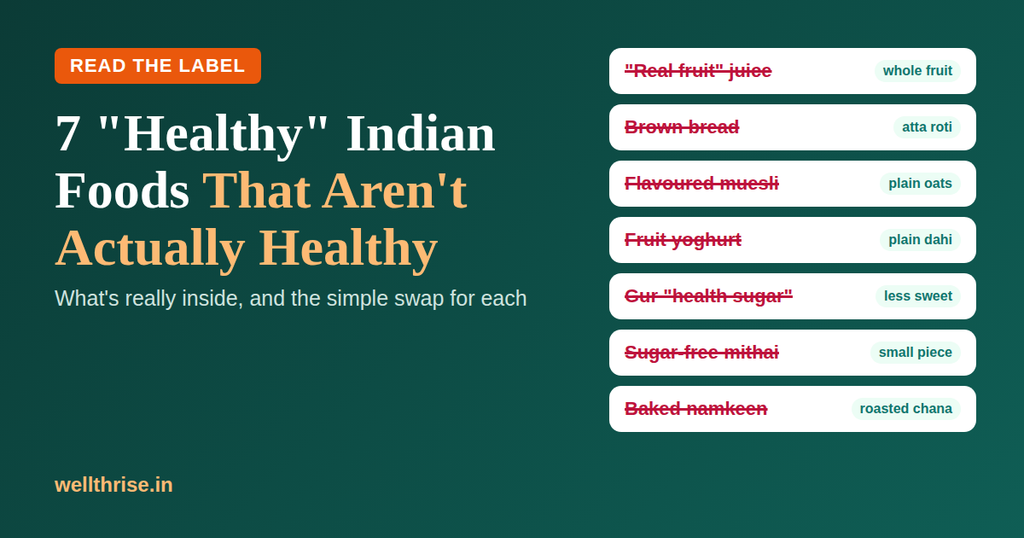
7 “healthy” Indian foods that aren’t as healthy as the packet says.
Brown bread, fruit juice, jaggery, muesli: things we buy because they sound good for us. Here’s what’s actually inside, and the simple swap for each. (Indian Foods)
- A “real fruit” drink can legally contain as little as 10% fruit, according to India’s own dietary guidelines.
- “Brown” bread only has to be 50% whole wheat. The rest can be maida.
- Jaggery and honey are still sugar. Your body counts them the same way.
- “Sugar-free” doesn’t mean low calorie, and “multigrain” or “millet” doesn’t mean no maida.
None of these foods is poison. The problem is the health halo: a word on the packet (“natural”, “multigrain”, “sugar-free”, “with real fruit”) makes us eat more of it, more often, without checking. In 2024, the ICMR’s National Institute of Nutrition (ICMR-NIN) warned in its dietary guidelines that many packaged-food label claims can mislead buyers. Here are seven that catch most Indian households.
The 7 foods
1Packaged fruit juice and “real fruit” drinks
The ICMR-NIN guidelines point out that a drink can claim to be made with real fruit pulp even when fruit is only about 10% of it. The rest is mostly water and sugar. A popular mango drink, for example, has about 15.8 g of sugar per 100 ml, according to a fact-check of its label. So one 200 ml bottle has about 32 g, which is more than the WHO’s ideal daily limit of about 25 g of free sugar for an adult.
Even 100% juice with no added sugar loses the fibre of the whole fruit, and the WHO counts its sugar as “free sugar”, the kind to cut back on.
2Brown bread and “multigrain” bread
Under FSSAI rules, bread sold as brown bread needs only 50% whole wheat flour, and whole wheat bread needs 75%. The other half of a brown loaf can be refined flour (maida). The brown colour can also come partly from added colour or caramel. And “multigrain” just means more than one grain. A loaf can be mostly maida with a sprinkle of oats and seeds on top.
3Muesli, granola and “healthy” breakfast cereals
Oats are healthy. Many flavoured muesli and granola packs aren’t mostly oats. Look at the ingredient list, which is printed in order of quantity: in many fruit-and-nut or chocolate versions, sugar, honey, jaggery, glucose syrup or “dried fruit with sugar coating” appear in the first few ingredients. Granola is also baked with oil, which adds calories fast. A small bowl easily turns into two.
4Flavoured yoghurt and packaged lassi
Plain dahi is one of the healthiest everyday foods in India. Flavoured yoghurt cups, fruit yoghurts and sweet lassi packs are different: most add sugar, and in some it’s the second ingredient after milk. The protein and probiotic claims on the front don’t cancel out the sugar on the back.
5Jaggery and honey as a “healthy sugar”
Gur has about 375 kcal per 100 g, and most of it is sucrose, the same sugar as white sugar. It does have some iron, potassium and magnesium, but a teaspoon contains only a tiny amount. That’s too little to matter, as diabetologists quoted by The Week’s fact-check point out. Studies disagree on whether it raises blood sugar any more slowly. The WHO counts honey as free sugar too.
6“Sugar-free” mithai, biscuits and chocolates
This one is straight from ICMR-NIN: “sugar-free” foods can still be loaded with fat, refined flour and starch, and even hidden sugars like maltitol, fructose, corn syrup or molasses. Sugar-free kaju katli is still mostly cashew and ghee. A sugar-free biscuit is still a maida biscuit. People also tend to eat more of something labelled sugar-free.
7“Baked” namkeen, millet cookies and ragi chips
Millets are good for you. A packet that says “ragi” or “millet” in big letters may not be mostly millet. Check the ingredients: refined wheat flour is often first, with millet much further down. “Baked, not fried” snacks can still be high in salt and oil, and both are easy to overeat straight from the packet.
🧃 How much sugar is in your daily juice?
Pick how much packaged fruit drink you have in a day. We use about 15.8 g of sugar per 100 ml, which is typical for sweetened fruit drinks, and compare it with the WHO’s ideal limit of 25 g of free sugar a day.
The 30-second label check
- Turn the packet over. The front is marketing. The ingredient list and nutrition table are the facts.
- Read the first three ingredients. They make up most of the product. If sugar, maida or oil is among them, it’s a treat, not a health food.
- Count the names for sugar: sugar, glucose, fructose, corn syrup, maltodextrin, invert syrup, honey, jaggery, molasses. Several of them in one list add up.
- Check “per 100 g” and not “per serving”. Serving sizes on packets are often smaller than what people actually eat.
- Look at sodium for salty snacks. The higher it is per 100 g, the more of a once-in-a-while food it is.
✅ Your kitchen check
Tick the ones you eat or drink most days.
FAQ
Is brown bread healthier than white bread?
Only a little, and only if it’s mostly whole wheat. FSSAI rules let “brown bread” contain just 50% whole wheat flour. Bread labelled whole wheat needs 75%. Check that atta is the first ingredient.
Is jaggery better than sugar for weight loss?
No. It has about the same calories as sugar and is mostly sucrose. Its minerals are too small in a teaspoon to make a real difference. Reduce the total amount of sweetener instead.
Is 100% fruit juice with no added sugar okay?
It’s better than a sweetened fruit drink, but whole fruit is better still. Juice has no fibre and is easy to drink in large amounts, and the WHO counts its sugar as free sugar.
Are sugar-free sweets safe for people with diabetes?
Not automatically. ICMR-NIN warns they can contain fat, refined flour and hidden sugars. If you have diabetes, ask your doctor or dietitian what fits your plan.
Read next on WellthRise
Sources: Down To Earth on the ICMR-NIN Dietary Guidelines for Indians (2024) · FSSAI bread labelling standards · Fact Crescendo: sugar in a mango drink · The Week: jaggery vs sugar · WHO sugars guideline. This article is general information, not medical advice. If you have diabetes or another condition, follow your doctor’s guidance.
We write practical guides on money, tax, salary, wellness and India news. Rates, rules and dates come from official sources such as RBI, SEBI, the Income Tax Department, India Code and government notifications, linked in each article with the date we last checked them. We don’t accept payment to change what we write.
Our editorial policyReport an error