
RBI New Notes 2026: Plastic ₹10 and ₹20 Notes Are Coming. What Changes and Are Your Old Notes Still Valid?
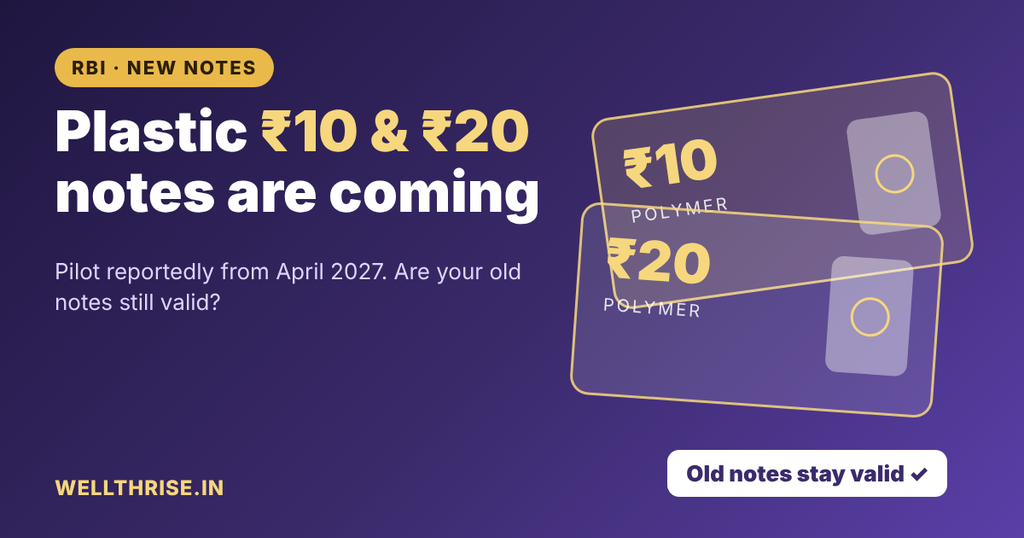
The RBI is getting ready to test polymer (plastic) banknotes, with a pilot reportedly from April 2027. Here is what has been confirmed, what is still just reported, and a quick checker to see if the notes in your wallet are still good.
- What’s new: the RBI plans a field trial of polymer ₹10 and ₹20 notes, 100 crore pieces of each, worth about ₹3,000 crore, the government told the Lok Sabha in July 2026.
- When: not officially announced. Reports say the pilot could start around 1 April 2027.
- Your old notes: nothing changes. Paper ₹10 and ₹20 notes stay legal tender, and the government says there is no proposal to replace paper currency.
- Same size: the new notes are expected to keep today’s dimensions, so ATMs and wallets won’t need changes.
What are the RBI’s new polymer notes?
Polymer notes are printed on a thin, flexible plastic film called BOPP (biaxially oriented polypropylene) instead of the cotton-based paper used for Indian notes today. They look and feel like smooth, slightly glossy notes, usually with a clear see-through window as a security feature. Australia issued the world’s first in 1988, and more than 50 countries now use them, including Canada, the UK, Singapore, Malaysia, Vietnam and New Zealand.
India is starting with the two notes that wear out fastest. ₹10 and ₹20 notes change hands constantly, get folded, soaked and stuffed into pockets, and make up nearly a quarter of all notes in circulation by count, but only about 1.3% by value. Replacing them so often is expensive.
RBI polymer notes: the timeline so far
The RBI first invited bids for 100 crore polymer ₹10 notes. In 2012 the Centre approved a field trial in Kochi, Mysuru, Jaipur, Shimla and Bhubaneswar, but it was shelved over technical and security-clearance problems.
RBI Governor Sanjay Malhotra said after the policy meeting that a polymer note proposal was under consideration, with no final decision yet.
The RBI’s printing subsidiary, Bharatiya Reserve Bank Note Mudran (BRBNMPL), floated a global tender for 68,000 reams of polymer substrate, split equally between two denominations. Bidders must keep China- and Pakistan-linked operations, materials and staff out of the project, and the film must not contain animal tallow.
Minister of State for Finance Pankaj Chaudhary told the Lok Sabha the trial will cover 100 crore pieces each of ₹10 and ₹20, about ₹3,000 crore in all, and that polymer notes will be issued alongside paper notes.
The Governor said polymer notes could last two to four times longer than paper.
Reports say six bids have come in, the pilot could start from 1 April 2027, and the notes will keep today’s size so that banks don’t have to re-tune their ATMs.
The RBI hasn’t yet released the design, the launch date or the cities for the trial. Treat any viral “photo of the new plastic note” with suspicion until it comes from the RBI itself.
Is my note still valid? Quick checker
New notes always start a wave of “old notes will be banned” rumours. Pick the note you have to see what the RBI rules say.
Check your note
Based on RBI notifications as of 31 October 2026.
Why the RBI wants plastic notes
- They last longer. Polymer resists water, dirt and tearing. The Governor has said they could last two to four times as long as paper notes.
- Printing costs are high. The RBI’s spending on printing notes rose to ₹6,372.8 crore in 2024-25 from ₹5,101.4 crore a year earlier, according to its annual report, before easing to about ₹4,875 crore in 2025-26.
- Millions of notes are destroyed. About 2,380 crore (23.8 billion) soiled notes were disposed of in 2024-25.
- Cash isn’t going away. Despite UPI, over 17,000 crore notes worth about ₹41 lakh crore were in circulation on 31 March 2026.
- Harder to fake. Clear windows and special films are tough to copy. Counterfeit notes detected rose to about 2.3 lakh pieces in 2025-26 from 2.17 lakh a year earlier.
Paper vs polymer notes: what changes for you
| Today’s paper note | Polymer note | |
|---|---|---|
| Material | Cotton-based paper | Plastic film (BOPP) |
| Life | Short for ₹10 and ₹20, which wear fast | About 2–4 times longer |
| Water | Goes limp, tears, ink fades | Usually survives getting wet, even a wash |
| Security | Watermark, thread, latent image | Clear window and features that are hard to copy |
| Size | ₹10: 63 × 123 mm, ₹20: 63 × 129 mm | Expected to stay the same |
| Cost to print | Lower per note | Higher per note, cheaper over its life |
| Weak spots | Tears, dirt, moisture | Can shrink with high heat (don’t iron it), slippery to count, folds stay |
✅ Good news
- Cleaner notes that don’t go limp and grubby
- Fewer torn notes refused by shopkeepers
- Harder for fraudsters to copy
- Lower long-run cost for the RBI, and the taxpayer
⚠️ Things to get used to
- A different feel, which may confuse people at first
- Keep them away from very high heat, like a hot iron or a car dashboard in May
- Fresh notes can stick together while counting
- Expect fake “plastic note” photos and scams before the real launch
Other new notes: the Governor Malhotra signature series
You may already have “new” notes without noticing. Since Sanjay Malhotra became RBI Governor in December 2024, the RBI has issued notes in the Mahatma Gandhi (New) Series carrying his signature:
- ₹100 and ₹200: announced in March 2025
- ₹10 and ₹500: announced on 4 April 2025
- ₹20: announced on 17 May 2025
Only the signature changed. The design, colour, size and security features are the same, and every earlier note of these denominations remains legal tender. There is nothing to exchange.
What about ₹2,000 notes?
The RBI withdrew ₹2,000 notes from circulation on 19 May 2023, but they are still legal tender. By 28 February 2026, 98.44% had come back, leaving about ₹5,551 crore with the public. Banks no longer exchange them, but you can:
- Exchange or deposit them at any of the RBI’s 19 Issue Offices, or
- Send them by India Post from any post office to an RBI Issue Office, for credit to your bank account.
Beware of scams: nobody from the RBI or a bank will call to “exchange your old notes for new polymer notes” or ask for your bank details to do it. New notes are simply issued through banks and ATMs. Report such calls on Sanchar Saathi.
RBI new notes FAQs
When will plastic ₹10 and ₹20 notes come out in India?
The RBI hasn’t announced a date. Reports in late October 2026 say the pilot could begin around 1 April 2027, after the RBI’s printing arm finishes buying the polymer film. A wider rollout would depend on how the trial goes.
Will my paper ₹10 and ₹20 notes stop working?
No. The government has said there is no proposal to replace paper notes. Polymer notes will be issued alongside paper ones, and all paper ₹10 and ₹20 notes remain legal tender.
Are the RBI’s new notes made of plastic?
The planned pilot notes are made of a polymer film called BOPP, a kind of plastic. All other notes in circulation today are still cotton-based paper.
Will ATMs need to change for polymer notes?
The RBI reportedly plans to keep the same size as today’s ₹10 and ₹20 notes, so ATM cassettes and sensors won’t need major changes. Pilot notes may initially be handed out at bank counters.
Which countries use polymer notes?
More than 50, including Australia (the first, in 1988), Canada, the UK, Singapore, Malaysia, Vietnam, New Zealand and Romania.
Are notes with writing on them still valid?
Yes. Writing or a stamp on a note doesn’t make it invalid; the RBI only asks people not to write on notes under its Clean Note Policy. Badly torn or damaged notes can be exchanged at bank branches under the RBI’s note refund rules.
Can I still use ₹2,000 notes?
They remain legal tender, but they are out of circulation and most shops won’t accept them. Exchange or deposit them at an RBI Issue Office, or send them by India Post to one.
Rates on fixed deposits also changed this month after the RBI’s rate hike. See what your money can earn with our FD calculator, and read what the October 2026 repo hike means for you.
Sources
Outlook Business: RBI floats global tender for polymer notes · Business Standard: Why RBI is considering plastic notes · NiftyTrader: Polymer notes likely from April 2027 · Dainik Jagran: RBI plans polymer note pilot · Taxscan: New ₹20 notes · Millennium Post: New ₹10 and ₹500 notes · Angel One: ₹2,000 notes status
Updated 31 October 2026 by the WellthRise Editorial Team. We’ll update this page when the RBI announces the pilot.
We write practical guides on money, tax, salary, wellness and India news. Rates, rules and dates come from official sources such as RBI, SEBI, the Income Tax Department, India Code and government notifications, linked in each article with the date we last checked them. We don’t accept payment to change what we write.
Our editorial policyReport an error