
Fake Khoya and Mithai: 5 FSSAI Home Tests to Check Your Diwali Sweets
Food officials are seizing tonnes of suspect mawa before Diwali again. Here’s how to check khoya, silver varq and milk sweets at home, which tests suit which sweet, and how to report a shop.
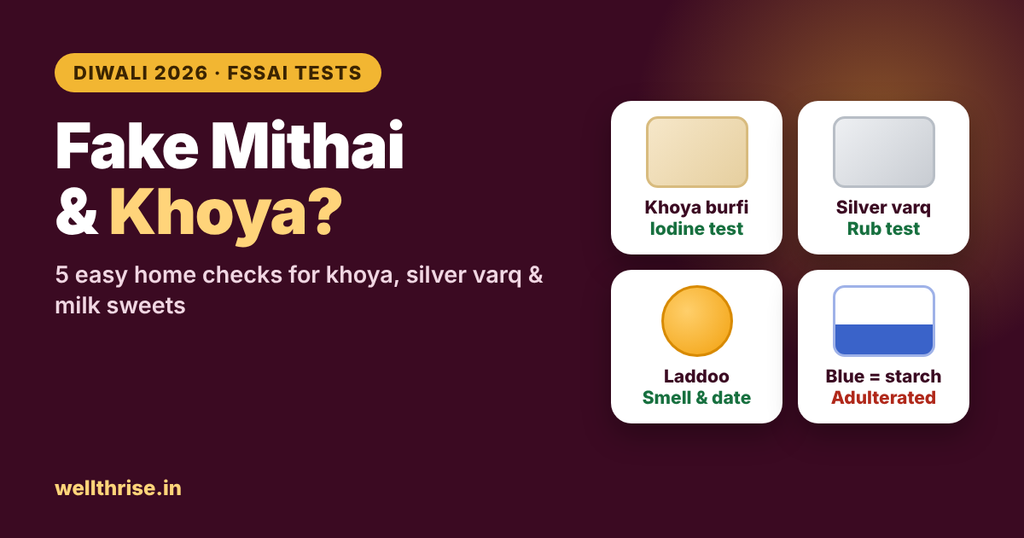
- Khoya: boil a little in water, cool it and add 2–3 drops of iodine tincture. A blue colour means starch has been added.
- Silver varq: real silver crumbles to powder between your fingers. Aluminium breaks into shreds or rolls into a tiny ball.
- The iodine test only works on pure milk sweets like burfi, peda and kalakand. Besan laddoo or gulab jamun will turn blue anyway, because flour is a normal ingredient.
- Loose sweets must show a best-before date on the tray. If the shop doesn’t display one, or the sweet smells sour, skip it.
Why fake khoya is back in the news
Demand for khoya (mawa) jumps several times over in the weeks before Diwali, and so does fake khoya. This October, police and food officials in Bhind, Madhya Pradesh intercepted about 1,250 kg of suspected adulterated mawa headed for Gwalior, after a mobile food lab flagged it; samples went to a laboratory in Bhopal for confirmation. Food officials in Indore seized 298 kg of mawa from a supplier on 29 October. Similar seizures are reported from Delhi, Punjab and Uttar Pradesh every festive season.
Common adulterants include starch or flour to add bulk, cheaper vegetable fat in place of milk fat, milk powder made into “synthetic” or fake khoya, and aluminium foil passed off as silver varq. Most of these can’t be spotted by eye, but a few simple tests from FSSAI’s DART (Detect Adulteration with Rapid Test) guide can catch the common ones.
Quick mithai checker
🍬 Is this sweet OK to eat?
Pick your sweet, then tap what you notice. The verdict updates as you go, and you don’t need to answer everything.
- Choose the type of sweet first, so we can tell you which tests make sense for it.
5 home tests for adulterated sweets
1. Iodine test for fake khoya (starch)
Boil about half a teaspoon of khoya (or crumbled burfi) with 5 ml of water, let it cool, then add 2–3 drops of iodine tincture from a chemist. If it turns blue, starch such as flour, potato or arrowroot has been added. No colour change is a good sign.
For: khoya, burfi, peda, kalakand, paneer, chhena2. Rub test for silver varq
Take a piece of the foil and crush it between two fingers. Pure silver breaks into a fine powder that almost disappears. Aluminium tears into shreds or rolls into a small ball. FSSAI’s guide also suggests rolling the foil into a ball and burning it: silver leaves glistening silver balls, aluminium turns to grey ash.
For: kaju katli, dry fruit sweets, barfi3. Palm test for khoya
Rub a little khoya on your palm. Good khoya feels slightly grainy, leaves a light greasy mark and smells of ghee or milk. Fake khoya often feels pasty, rubbery or dry and has little aroma, because it’s made from milk powder or vegetable fat.
For: loose khoya bought for cooking4. Shake test for detergent
Mix a small piece of milk sweet with an equal amount of water and shake hard. Pure milk makes only a thin layer of foam. Thick, lasting lather can point to detergent used to make synthetic milk.
For: rasgulla, rasmalai, milk cake, kalakand5. Look, smell and date check
Sour, rancid or musty smells, a slimy surface, mould spots or a sharp chemical taste all mean throw it away. Unnaturally bright yellows, oranges and greens are a warning: permitted food colours are limited by law, but some banned dyes can’t be detected at home, so it’s safer to buy lightly coloured sweets.
For: every sweet💡 These fake khoya and fake mithai checks are screening tests, not lab tests. A “pass” doesn’t prove a sweet is safe, and a blue iodine result is expected in any sweet that contains flour, rava or besan. If several warning signs show up together, don’t eat it and report the shop.
Which test works for which sweet?
| Sweet | Useful home tests | Main risk |
|---|---|---|
| Khoya burfi, peda, kalakand, milk cake | Iodine, palm, smell | Starch, milk powder, vegetable fat in khoya |
| Rasgulla, rasmalai, sandesh, chhena sweets | Iodine, shake, smell | Starch in chhena, spoilage (shortest shelf life) |
| Kaju katli, dry fruit sweets with varq | Varq rub or burn test | Aluminium foil instead of silver |
| Besan laddoo, gulab jamun, soan papdi | Smell, taste, date (iodine not useful) | Rancid ghee or oil, staleness |
| Jalebi, imarti, coloured laddoo or barfi | Colour check, smell | Non-permitted synthetic colours |
What the rules say about sweet shops
- Best-before date on loose sweets: since 1 October 2020, FSSAI has required sweet shops to display a “best before” date on the tray or container of every non-packaged sweet. The manufacturing date is optional.
- Licence or registration: every sweet shop needs an FSSAI licence or registration, and the number should be displayed at the shop. Packaged sweets must print it on the box.
- Silver leaf: FSSAI standards require edible silver leaf to be at least 99.9% pure silver.
- Colours: only specific permitted synthetic colours are allowed in sweets, and within limits.
How to report fake khoya or adulterated sweets
- Keep the sweet, the box or bill, and a photo of the tray label if you can.
- Complain on FSSAI’s Food Safety Connect app or the FoSCoS portal, or call FSSAI’s toll-free number 1800-112-100.
- You can also contact your district’s food safety officer through your state food safety department, which runs festival checking drives before Diwali.
- repeated vomiting or diarrhoea, especially in a child or older person
- signs of dehydration, such as very little urine, dizziness or a dry mouth
- blood in stool, high fever, or symptoms lasting more than a day
Smart buying tips for Diwali
- Buy closer to the day. Milk and chhena sweets keep for the shortest time, so buy them last and refrigerate them.
- Prefer busy, licensed shops where stock moves quickly, and check the best-before date on the tray.
- Be wary of very cheap khoya sweets. Real khoya needs about 5 litres of milk per kg, so it can’t be sold far below the market rate. A rock-bottom price is one of the clearest signs of fake khoya.
- Consider dry fruit sweets or home-made options for gifting, since they keep longer. Our “healthy” Indian foods that aren’t guide has more on what’s really in festive snacks.
Worried about other kitchen scares too? Our plastic eggs and egg freshness guide uses the same FSSAI-style checks.
Frequently asked questions
How can I check if khoya is fake at home?
Boil a small piece of khoya in a little water, cool it and add 2–3 drops of iodine tincture. Blue means starch has been added. Also rub some on your palm: real khoya feels slightly grainy and leaves a greasy mark with a milky smell.
How do I know if silver varq is real?
Crush it between your fingers. Real silver crumbles into fine powder. Aluminium foil tears into shreds or rolls into a ball. Burning a rolled piece also works: silver leaves shiny silver balls, while aluminium becomes grey ash.
Why did my besan laddoo turn blue in the iodine test?
Because besan is a starch. The iodine test only tells you something for sweets that should be made from milk alone, like burfi, peda, kalakand and chhena sweets.
Is it mandatory for sweet shops to show a best-before date?
Yes. Since 1 October 2020, FSSAI has required shops to display a best-before date for loose sweets on the tray or container.
Where can I complain about adulterated sweets?
Use FSSAI’s Food Safety Connect app or FoSCoS portal, or call the toll-free number 1800-112-100. You can also contact your district food safety officer.
Sources: FSSAI DART (Detect Adulteration with Rapid Test) guide, Eat Right India; Deccan Herald: FSSAI best-before rule for loose sweets; Free Press Journal: Bhind mawa seizure (26 October 2026); Amar Ujala: Indore mawa seizure (29 October 2026); FSSAI FoSCoS portal.
Last checked: 31 October 2026. This article is general food-safety information, not medical advice.
We write practical guides on money, tax, salary, wellness and India news. Rates, rules and dates come from official sources such as RBI, SEBI, the Income Tax Department, India Code and government notifications, linked in each article with the date we last checked them. We don’t accept payment to change what we write.
Our editorial policyReport an error